
Flying with Bromptons
A practical guide based on our experiences
A Brompton is unusually practical for air travel because it folds close to the dimensions of ordinary checked luggage. Flying with one is still not effortless, but it is much simpler than flying with a full-size bicycle.
Check the airline rules before you pack
Bicycles and other sporting equipment are not always treated like ordinary suitcases. Delta currently accepts bicycles up to 115 linear inches under its stated baggage rules, while United says it waives oversized-bag fees for properly packed bicycles; weight limits, packing requirements and other charges may still apply. Policies differ by airline, route and ticket, and they change.
Our B&W cases are a few linear inches larger than the standard checked-baggage limit used by many airlines. In practice, agents have been much more interested in whether the cases were overweight than whether they exceeded the normal dimensions by a few inches. That is our experience, not a substitute for checking the current policy.
Many of our international business-class tickets allow 70 pounds per checked bag, but that is far from universal. Check both the airline’s sporting-equipment policy and the allowance attached to your particular ticket before you pack.
Business class and the Istanbul lesson
We usually fly overseas in business class using airline miles and credit-card points. The relevant advantage here is not just the seat: business-class tickets often include more generous baggage allowances and sometimes provide a smoother check-in process. For readers interested in points and miles, View from the Wing, Live and Let’s Fly, and The Points Guy cover that subject far better than we intend to.
A couple of years ago, we were flying home from Istanbul on Turkish Airlines. Unable to find the business-class check-in area, we tried the regular counters, where an agent wanted to charge us about €200 for each bicycle. We eventually found the business-class area, and those agents processed the same cases with no bicycle surcharge.
That experience does not mean business class exempts a bicycle from an airline’s rules. Turkish Airlines’ current policy includes reservation and special-baggage requirements. The lesson is narrower: your ticket, allowance and check-in counter can all matter, and a calm, polite approach gives everyone the best chance of resolving a disagreement.
How should the bike be packed?
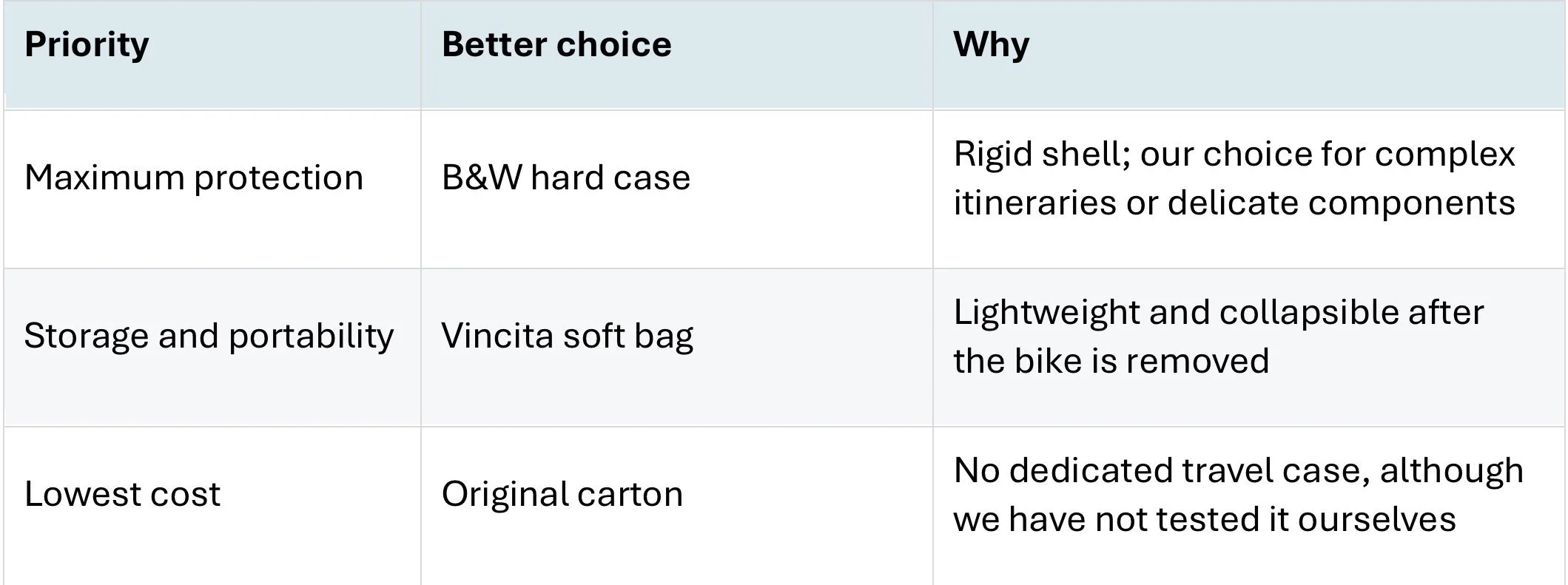
We know of three practical categories of choices. The owner of Freedom Folding and Electric Bikes in Boulder told us that he often checks his Brompton in its original cardboard shipping carton, carefully taped. We have not tried that method ourselves, but it is clearly the least expensive option.
We have flown with Vincita Sightseer padded bags and B&W hard-sided cases. The Vincitas are light and collapsible, making them easier to store and transport after arrival. The B&W cases are bulky and awkward, but they provide much stronger protection.
Our detailed gear review of the Vincita Sightseer and B&W hard-sided case covers protection, packing, storage, wheels, handles, custom padding, prices and the damage we have experienced with both cases.
Use the airline’s check-in counter, NOT the curbside check-in
In March 2026, we flew from Denver to Los Angeles on United and continued to Narita on Singapore Airlines on a separate ticket. United’s policy at the time (always check!) indicated that United could check our luggage from Denver through to LAX and onward to Tokyo, but the curbside staff could not handle the unusual request. Feeling rushed, we checked everything only to Los Angeles.
At LAX, we collected two bike bags, two other checked bags and our carry-ons, moved everything to the international terminal, checked it again and went through security a second time. It was exhausting and avoidable. If an itinerary involves separate tickets, partner airlines or any unusual baggage request, use the airline’s staffed counter and leave time to sort it out.
Checking and collecting the bikes
Checking either type of case has usually been straightforward when we are within our baggage allowance. If asked what is inside, we sometimes begin with “bike parts” because that distinguishes a folded Brompton from a conventional full-size bicycle box. No one has ever inquired further, but if an agent specifically asked whether the case contains a bicycle, we would answer plainly and make sure it complies with the airline’s policy.
Occasionally, after the bags are tagged, we have been asked to carry them to a separate oversized- or odd-shaped-baggage drop. It is an easy extra step, but another reason to allow a little time.
At the destination, the cases usually appear on the regular carousel, but sometimes they go to oversized baggage. At unfamiliar airports, we split up: one of us watches the carousel while the other checks the oversized-baggage area, and whoever sees a bike first sends a text.
And then there is the overhead bin
We once met a man who said he puts his folded Brompton in the aircraft’s overhead bin. Reddit is full of Brompton riders who say they do just that. We do not know how consistently it works, whether it meets a particular airline’s carry-on limits or what happens when the bins are small or full, so we are not recommending it.
If anyone does try it, please enclose the bike in a rinko bag or something similar, such as an IKEA DIMPA bag. A bare bicycle has grease and road dirt that could easily soil the bin or another passenger’s belongings. We always remember that we’re informal “ambassadors” for flying with Bromptons, and go out of our way to not cause issues for anyone else.
In conclusion
Choose a soft-sided bag when portability and storage at the destination matter most.
Choose a hard case when protection in transit matters most.
Whichever method you use, check the current airline rules, stay within the weight allowance and leave time for an unexpected extra step.