
What does “mobility” mean?
“Mobility” sounds like a simple concept. It isn’t.
In healthcare, disability law, transportation policy, and everyday life, “mobility” can mean very different things.
Medicare often looks at mobility through a specific lens: can a person move around the home and accomplish essential daily activities such as bathing, dressing, eating, and using the bathroom? That makes sense for a health-insurance program deciding whether to pay for a walker, wheelchair, or scooter.
But mobility does not stop at the front door.
Can we get through the long aisles of a grocery store? Cross the street before the crosswalk light runs out? Tour a large museum? Join our family for an outing? Walk from a train station to a hotel? Push a grandchild in a stroller? Explore the cobbled streets of a medieval European town? Spend an afternoon in a park?
These are mobility questions, too.
The circumstances differ, but the underlying question is the same: what combination of physical and mental ability, adaptation, equipment, environment, and transportation allows a person to move through the parts of life that matter to them?
That question has become increasingly important to us as we have gotten older.
There are things we no longer do the way we once did them. Hiking eight miles through a state park is much less likely these days.
But riding 31 miles through the Dutch countryside?
Entirely possible, even probable.

Mobility is not only about how far we can walk. A connected path can turn miles of countryside into accessible territory.
North of Amsterdam towards Zaandam.
That sounds contradictory only if walking is treated as the default measure of mobility.
It shouldn’t be.
A person may have difficulty walking any significant distance and still be able to bicycle comfortably. Someone may manage a few hundred yards on foot but travel several miles using a kick scooter. Another person may do well with trekking poles, an e-bike, a walker, a wheelchair, or some combination of them.
Mobility is not one ability.
Disability is not the lack of all ability.
Mobility is a collection of abilities.
The home and the wider world
This is where some formal definitions of mobility can become misleading.
For insurance purposes, the question may be whether a piece of equipment is necessary inside the home. For the person actually living with a mobility limitation, the bigger question may be whether the equipment allows active participation in the wider world.
Those are not the same thing.
A mobility scooter might be essential for shopping but unnecessary inside a small house where a walker is used. A folding bicycle might provide tremendous independence outside the home but be of no use whatsoever in the grocery store or between the bedroom and the kitchen.
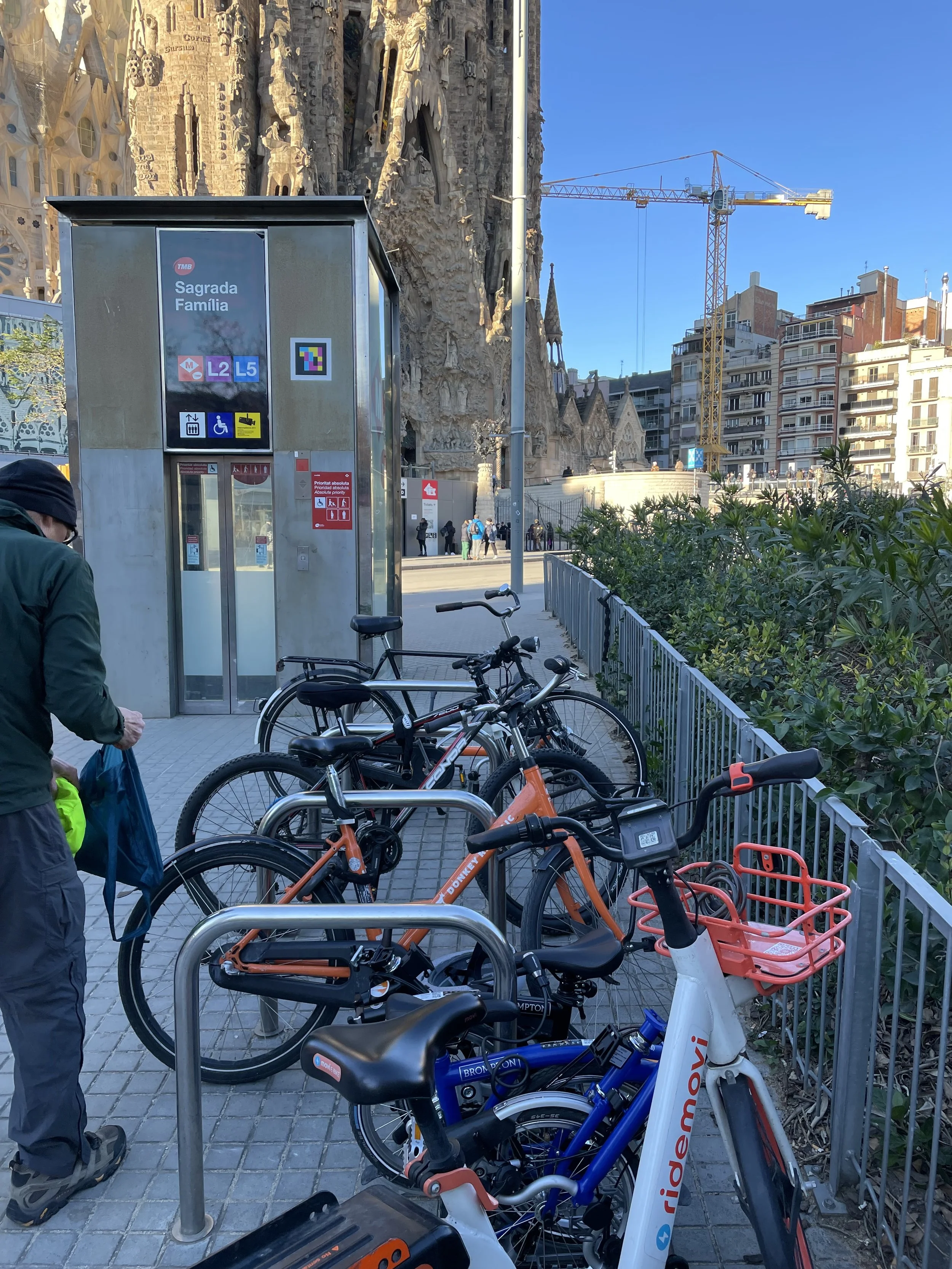
Mobility outside the home is rarely about one device. In Barcelona, beside Sagrada Família, our folded Bromptons, bike share bikes, city bicycles, and an accessible Metro entrance all occupy the same transportation landscape.
That does not make any device less important.
It simply means they solve different problems.
Tools, not labels
We are not lawyers, doctors, or rehabilitation specialists, and we are not trying to decide which devices officially qualify as mobility aids under any particular law or insurance program.
We are more interested in another question:
What allows a person to keep doing the things that matter to them?
Sometimes the answer will be a conventional mobility device. Sometimes it may be something less conventional. That is where bicycles enter the story.