
When a bicycle becomes a mobility device
Most people do not look at a bicycle and think mobility device.
They think childhood afternoons, fitness rides, family recreation, Tadej racing, daily commuting, or perhaps a leisurely ride on a Sunday afternoon.
But what happens when a person can bicycle far more easily than they can walk?
At that point, the distinction becomes much less obvious.
For us, this is not an abstract question.
One of the most important things we have learned is that walking ability and cycling ability are not the same.
Someone who finds a long walk exhausting or impractical may be able to ride many miles comfortably.
That difference can completely change the size of the world available to them.
A grocery store that’s too far from home on foot may suddenly be easy to reach. A large park that would otherwise be inaccessible becomes explorable. A recreation center that’s actually faster to get to by bike versus car becomes a pedal-powered treat. A quiet country lane turns into an afternoon adventure rather than an impossible distance.
That is not simply exercise.
It is mobility.
John on the road in Japan. For us, cycling can turn distances that would be difficult on foot into part of the day’s journey.

An unconventional idea — but not an entirely new one
Disability law already recognizes that some people use devices for mobility that were not designed as conventional wheelchairs.
Under the Americans with Disabilities Act, the role of a device can depend on who is using it and why, although safety and setting still matter.
Researchers have also documented occasional insurance or state-program funding for adaptive bicycles and tricycles, although coverage is inconsistent and often denied.
Medicare is generally much more restrictive. To qualify as durable medical equipment, an item must be primarily and customarily medical, generally not useful without an illness or injury, and appropriate for use in the home. Coverage for power mobility devices also focuses on limitations in daily activities inside the home. Those requirements make an ordinary bicycle particularly difficult to fit into the system.
A person might qualify for a wheelchair or powered scooter because walking is difficult, while a bicycle or tricycle may offer a different kind of range in settings where riding is possible.
The healthcare system may classify one as a mobility device and the other as recreation, even when both help the person participate in daily life.
A recent post in a Medicare forum captures the tension well. A 71-year-old partial paraplegic, asking whether his Medicare Advantage plan might cover a trike, wrote:
“what is so strange is i qualify for a motorized wheelchair”*
He also explained that he still wanted to take a road bike on a 20-mile fun ride after work.
Powered mobility can be liberating and essential. At the same time, someone who retains the strength, balance, coordination, and desire to pedal may find that a cycle offers an additional way to move—not a replacement for another device, but another useful option.
The best tool is the one that fits the person’s abilities, environment, and goals.
Why folding matters
A folding bicycle adds another dimension.
A conventional bicycle can itself become a transportation problem. It becomes a storage problem. It becomes a bike-grease-on-the-cushion problem. It becomes a why-do-the-pedals-bash-my-shins problem. It may require a rack, special storage, or advance arrangements on trains, buses, aircraft, and ships.
A folding bicycle can travel with the person using it.
It can fit into a car. It can go onto many trains. It can be stored in a hotel room. It can travel as luggage. It can accompany someone through an entire trip rather than becoming something that must be rented or arranged at every destination.
That portability matters because a mobility tool is useful only if it is available when needed—not three hours later and a mile away at a rental station.
This is one reason folding bicycles have become so important to the way we travel.
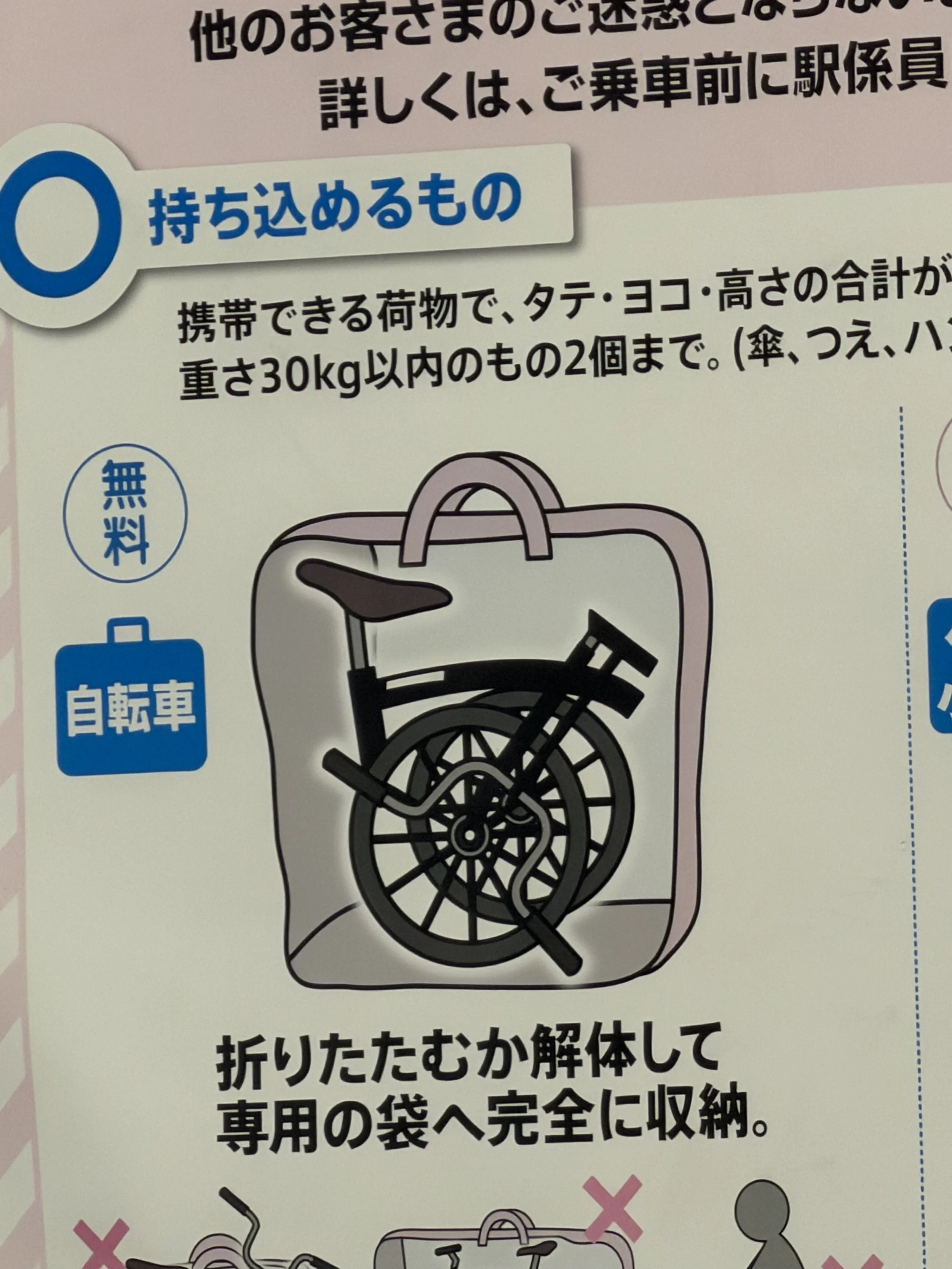
A folding bicycle can travel as part of the journey. In Japan, signs in railway stations explicitly show bicycles folded or disassembled and packed in a carrying bag.
But I’m not going to carry any bag with a 30kg bike inside!
Not every bicycle is a mobility device
We are not suggesting that bicycles should universally be classified as disability equipment.
For most people, they are not.
The point is simpler.
The same object can serve a very different function depending on the person using it.
A bicycle can be recreation for one person, transportation for another, and an extraordinarily effective mobility tool for someone else.
That is why we prefer to think about function before labels.
Instead of asking:
Does this look like a mobility device?
Perhaps the better question is:
Does this device allow someone to go places they otherwise could not go?
For some people — us — the answer regarding folding bicycles is an emphatic YES!
*Source: Reddit, r/medicare, “My Mobility Aid,” August 5, 2026.