
How We Found the Right Travel Bikes for Us
Dahons, bike share, rentals, and eventually Bromptons
We did not begin with Bromptons. We arrived at them gradually, after years of trying different ways to put bicycles into our travels. Each approach solved one problem and created another. Along the way, we learned that the question is not simply, “Is this a good bicycle?” For travel, the better question is, “Does this bicycle work as part of the whole trip?”
Our Dahons proved that small-wheeled folding bikes could be capable, real bicycles. Bike share and rentals showed us the freedom of having a bike waiting at the destination. The Bromptons eventually brought those lessons together: our own familiar bicycles, compact enough to move through the rest of the trip with us.

This really happened, but we can’t find the photo we took. This is an AI-generated reconstruction. Note that no parts were lost; we rode the Dahons in San Diego later that day.
The Suitcase on the Tarmac
In March 2014, we were flying from Denver to San Diego on Southwest Airlines. We were seated on the right side of the airplane, and before takeoff I could see the baggage handlers outside our window loading luggage toward the aircraft.
Then one of our enormous gray Samsonite clamshell suitcases fell off the baggage cart.
We knew exactly what was inside: one of our folding Dahons, carefully packed with both wheels removed and stowed. From our seats, we could only watch as the suitcase sat on the tarmac and the baggage crew continued working around it.
That moment captured the problem perfectly. The Dahons themselves were very capable travel bikes. The problem was everything required to get them there.
We kept working on it.
Our Dahons: Very Capable Bikes in Very Uncooperative Suitcases
Long before we owned Bromptons, we traveled with a pair of Dahon folding bicycles. We bought them used from a fellow in Grand Junction, Colorado. John’s was a blue Dahon Mu, and mine was a red Dahon Speed.
They were quite different from the Bromptons we ride now. The Dahons had 20-inch wheels and folded in half at a large hinge in the main frame. The handlebar mast folded down, and the seatpost dropped. The photos in front of our garage door make the basic fold easy to see: the bicycle becomes much shorter, but the two 20-inch wheels still define a fairly large folded package. The system was simple and sturdy, but the folded bike was considerably larger and heavier than a Brompton.


But they were very capable bicycles.
We put knobby tires on them and took them to Acadia National Park, where they did beautifully on the gravel carriage roads. They were not especially sophisticated bicycles, but they were comfortable, durable, and surprisingly versatile. Pavement, gravel, rougher paths — with the large 20” wheels they handled quite a bit a varied terrain. We even rode them on parts of the Colorado Midland rail trail above Buena Vista.

They Went Places
We traveled with the Dahons to Acadia, Washington, D.C., Coronado, California, Walt Disney World in Florida, and Miami Beach. They also became useful transportation at home. One day when our church was renting the Paramount Theatre in downtown Denver, I took the bus to Union Station and then rode my red Dahon from there to the theater to volunteer. It was fun, and it was an early glimpse of what a folding bicycle could add to an ordinary day.

The Dahons were good enough bikes that the riding was rarely the problem. The problem was getting them there.
The Suitcases
I found two enormous old Samsonite hard-sided clamshell suitcases that were just large enough to hold the folded bicycles. The cases had no wheels and only one small carrying handle. Once a bicycle was packed inside, moving one of those suitcases through an airport was an adventure all by itself.
The bikes also needed more disassembly than we would have liked. Both wheels had to come off before a bike would fit into its case. With conventional caliper brakes, removing and reinstalling the wheels was not especially difficult, but it was time-consuming. Then the bicycle, wheels, and other pieces had to be arranged carefully inside the suitcase.

And, of course, packing the bicycle at home was only half the process. When we arrived, we had to open the suitcase, remove everything, put the wheels back on, adjust what needed adjusting, and turn the contents of the case back into a bicycle.

What the Dahons Taught Us
Eventually, traveling with the Dahons simply became too cumbersome. They were heavier than the Bromptons we would later own, and the old Samsonite cases made every airport transfer harder. The repeated disassembly and reassembly also took time at both ends of every trip.
We did not sell the Dahons because we did not like riding them. We sold them because transporting them had become too much work.
They had already taught us something important, though: a small-wheeled folding bicycle could be a remarkably capable travel bike. What we still needed was a bicycle that was easier to travel with.

Bike Shares & Rentals: When the Bike Is Already There
Bike share and rental bikes solve one of the biggest problems with traveling by bicycle: the bicycle is already waiting for you when you arrive. No airline luggage, no oversized suitcase, no assembly, and no need to transport your own bike from place to place.
We have successfully used bike-share bikes in Washington, D.C., Tampa Bay, Miami Beach, and London. We have also rented bicycles for shorter rides in places such as Vancouver, British Columbia, and for a much longer stay at Balmoral in Scotland. The experiences have ranged from excellent to barely workable.

A large bike-rental fleet in Flåm, Norway (August 2019)


Capital Bikeshare (with the red Dahon) in Washington DC
Why Bikeshare and Rentals Can Work So Well
The biggest advantage is simple: you do not have to bring your own bicycle. Someone else stores and maintains the bike, and in a large city there may be stations or rental shops close to the places you want to explore.
Bike share can be wonderfully spontaneous. You can decide to ride because the weather is good, because you discover a trail, or simply because a row of bikes happens to be sitting nearby.
A good rental can be even better if the bike is delivered to where you are staying and you can keep it for several days. That gives you time to get comfortable with the bike and use it repeatedly without making a separate trip to a rental shop every time you want to ride.
Balmoral: Rentals at their Best
The best rental-bike experience we have had was at Balmoral in Scotland in July of 2015. There were four of us, and we arranged to have three mountain bikes and one e-mountain bike delivered to where we were staying for the week.
The e-mountain bike was a Haibike with a Bosch mid-drive motor. It was rugged, highly capable, and more fun than I think I had ever had on a bicycle to that point.
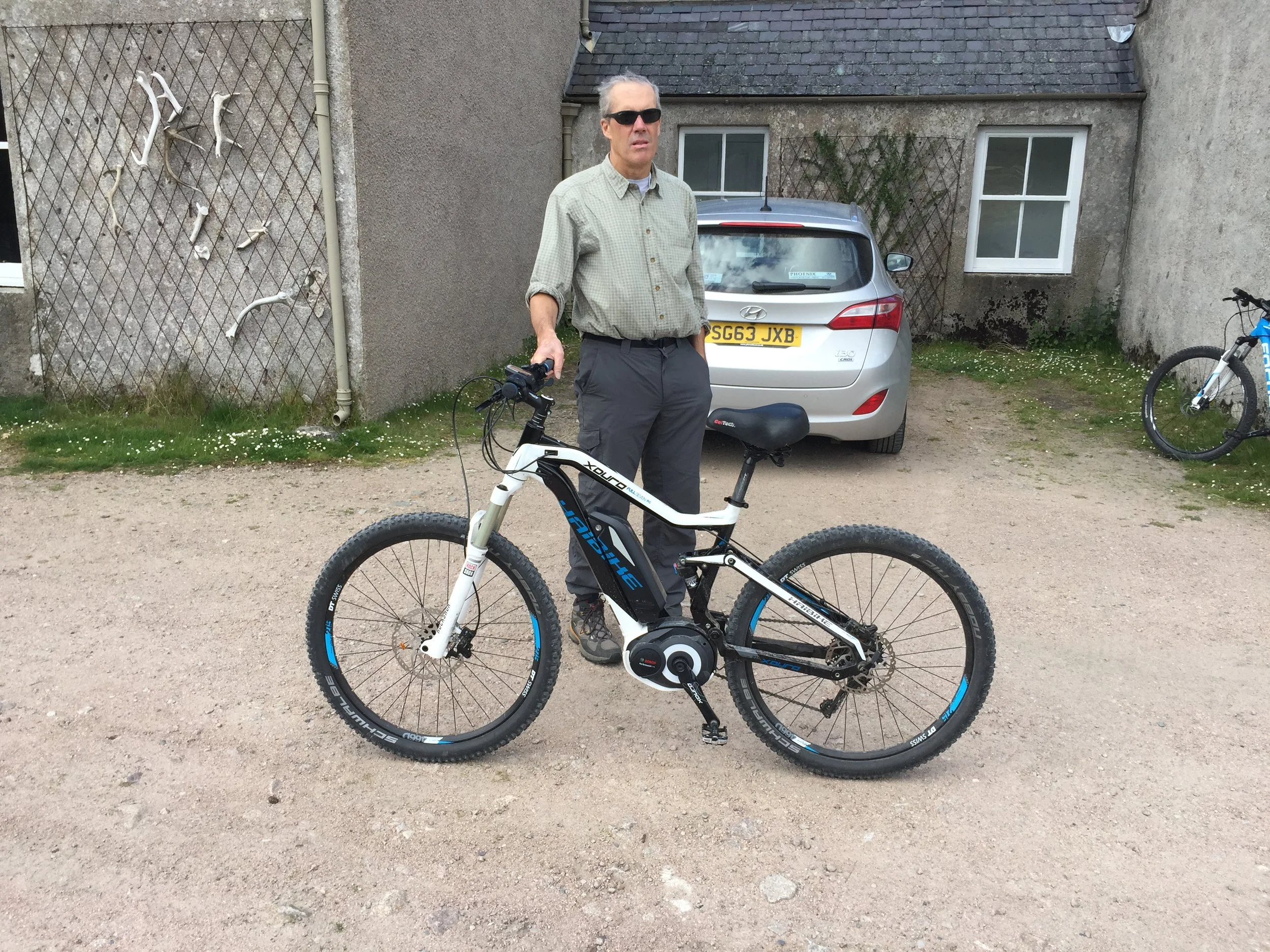
The cost was reasonable for what we were getting, and it was worth it. Because we had the bikes for the week, they became part of the trip rather than a one-afternoon activity.
We rode the estate’s Rover Tracks, the same network of routes that Queen Elizabeth II hiked and drove. Alex and Lil rode across the saddle to Balmoral, and the bikes were exactly the right tools for the terrain.

That experience showed us how good rental bikes can be when the right bikes are delivered to the right place and you have enough time to really use them.
Short-Term Rentals: More of a Gamble
Most rental experiences are not quite like Balmoral. More often, you have to get yourself to a bike shop, rent whatever is available, and return it within a few hours or by the end of the day.
In June of 2016 we rented bikes for an afternoon in Vancouver, British Columbia, near the harbor. Alex’s bike worked reasonably well, although it was a bit small for him.

Mine was another story. The bike was badly worn and clearly had not received much recent attention. I made it work, but “deferred maintenance” seemed to be a theme at that rental shop.
In contrast, we rented bikes at Echo Sports in Quebec City, Montreal, just across from the cruise port. The bikes were good quality, well maintained, and fit well.
That is one of the biggest drawbacks of renting a bike: you do not really know what condition it will be in until you get there. Brakes may need adjustment, shifting may be rough, tires may be tired, and the saddle may be uncomfortable.
Fit is another issue. The bike may technically be rideable, but will it actually fit you? A rental shop may not have the ideal frame size available, and bike-share bicycles usually offer only limited adjustment.
Bike Share: Easy When the System Works
Bike share removes the need to visit a rental shop at all. In the best systems, there are bikes throughout a city, the sign-up process is straightforward, and you can simply unlock a bike, ride, and leave it at another approved location.


Tampa Bike Share in 2015, before everything was done on an app.
Most of the time, bike share is not prohibitively expensive for occasional use. But costs can add up, especially if the system is priced for short point-to-point trips rather than longer recreational rides.
But You Have to Make the System Work
Every bike-share system has its own rules. You may have to download an app, create an account, enter a credit card, verify a phone number, understand a pricing structure, and figure out how that particular system unlocks and returns its bikes.
When you are traveling in another country, every one of those steps can become more complicated. You also have to know where the bikes are and where you will be allowed to leave them.
And any individual bike can have a problem. A bike that appears available may have a flat tire, weak brakes, damaged gears, a bad seat, or some other mechanical issue.
Bike-share bikes are also usually very heavy. That makes sense because they are built to survive constant use, weather, and riders of many different sizes and abilities. And if you prefer to wear a helmet, you still have to solve that problem yourself. The bicycle may be waiting for you, but the helmet usually is not.
Shanghai: We May Have Succeeded Without Knowing It
In Shanghai, China, we found plenty of shared bicycles and decided to try renting them. The instructions were in Chinese, so I worked through the process using Google Translate.
I could not quite make the translation work well enough to be certain that I understood what I was doing, and eventually we gave up without riding. Later, I discovered that my credit card had been charged.
Apparently, we may actually have completed enough of the rental process to succeed. We just did not know that we had.

Turkey: The Phone Number Problem
We ran into a different barrier in a small town in Turkey. The bicycles were there, and we wanted to use them, but the sign-up process required a telephone number with a Turkish country code. Without one, we could not complete the registration.
After we returned home, I found that it may be possible to obtain an international telephone number through an app called “Telfon.” In theory, something like that might make it possible to register for a local bike-share system that requires a country-specific number. We have not tried it yet, so for now it belongs in the category of ideas to test on a future trip.

Sometimes the Whole System is Down
Miami Beach taught us another lesson. A rack full of bicycles is not necessarily a rack full of available bicycles.
On one occasion, there were plenty of bikes physically sitting in the rack, but the bike-share system itself was down. We could see the bikes. We could touch the bikes. We just could not rent any of them.
“A rack full of bicycles is not necessarily a rack full of available bicycles.”
The Tradeoff
Bike share and rentals can be excellent ways to add cycling to a trip without transporting your own bicycle. At their best, they are easy, flexible, and reasonably priced. A multi-day rental delivered to where you are staying can come surprisingly close to having your own bike with you.
But you give up control. You are dependent on someone else’s equipment, maintenance, sizing, app, payment system, phone-verification rules, docking network, and technology.
That is the central tradeoff: the bike is already there, but it may not be the bike you would have chosen, and you still have to make someone else’s system work.

November, 2016. Lily (turquoise jacket, getting on her bike) and I rented bicycles and rode along the Appian Way in Rome. The cobbles made it difficult to ride on the road itself. No better way to have fun with your daughter!
Our Bromptons: When the Bike Became Part of the Trip
By the time we bought Brompton C-Line bikes in the summer of 2022, we already knew that we liked traveling by and with bicycles. We had taken folding Dahons on airplanes. We had rented bicycles. We had used bike-share systems. We had learned that a bicycle could completely change the way we experienced a place.
What we had not yet found was a bicycle that fit easily into the rest of the trip.
The Dahons were capable bikes, but traveling with them was a production. Bike-share bikes were convenient when the system worked, but we were dependent on someone else’s equipment, app, payment system, and docking network. Rental bikes solved some problems but created others.
The Bromptons changed that.

The Bromptons in soft-sided Vincita bags at the Denver airport next to our trusty Osprey backpacks, ready to head to Tokyo.

On the MSC Lirica the night before we headed home from Athens, with the Bromptons in hard-sided B&H cases.
They folded small enough that we could begin treating them as another piece of travel equipment rather than as oversized sporting gear. They could go onto trains, into taxis, into hotel rooms, onto cruise ships, and through places where a conventional bicycle would have been awkward or impossible.
And once we arrived somewhere, we had our own bikes.
Not whatever rental bicycle happened to be available. Not a heavy bike-share bike. Not a bike with an unfamiliar saddle, brakes, or shifting. Ours.
They Give Us a Different Kind of Independence

In Pireaus, the port for Athens, just off the overnight ferry from Patmos.
That happened in Wissant, France. When the traffic became less pleasant than we wanted, there was no reason to keep riding just because we had bicycles with us. We folded the Bromptons, put them on a scheduled bus, and rode back.
Having a bicycle does not obligate you to ride every mile. It gives you another option.
The biggest change was not simply that the Bromptons folded smaller. It was that they gave us choices.
We could ride away from a cruise ship without arranging an excursion. We could get off a train and continue by bicycle. We could explore a town until something interesting appeared and then turn toward it. And if circumstances changed, the bicycles could change with us.

This was one of the most ambitious rides we’ve ever tried on our Bromptons. We had just taken the Shinkansen from Tokyo to Maibara, and needed to get from the station to our apartment in Nagahama, about 10km. With 2 Ospreys each. In the pouring rain. But we did it!
They Let Us Follow Our Curiosity
Some of our best rides have not been about completing a route. They have been about seeing something and wondering, “What’s over there?”
In Tallinn, we rode through nearly empty streets in the old city, followed bike lanes toward the Baltic, continued through forested areas, and made our way back toward the ship. The memorable part was not the mileage. It was the feeling that we could simply keep exploring because the bicycles were with us.

That freedom to wander is very close to the central idea behind Freedom Unfolded.
The world gets bigger again!
The Little Ritual Before a Ride
There is also a smaller, more personal part of the Brompton story. After a flight or a cruise, there is that moment when the luggage is finally in the hotel room and the bike case comes out.
Baggage tags come off. The bag opens. The folded bicycle appears.
And there is a little flash of excitement because suddenly the place outside the hotel window is no longer just something to look at.
We can go see it.

That wet, but exhilarating, bike ride from Maibara to Nagahama.

The Bromptons are not Magic
A farm in Eidfjord, Norway.
Bromptons are not the perfect bicycle for every possible ride. They have small wheels. They are not especially light. Airline travel still requires planning. Packing systems matter. Cruise cabins have limited space. Rough surfaces can be challenging. There are places where we would rather have a mountain bike.
But the question for us has never been whether a Brompton is the best bicycle for every ride.
The question is: What bicycle are we actually willing and able to bring with us?
For us, over and over again, the answer has been the Brompton.

For John, the Bike Means Even More
For John, walking long distances can be much harder than riding. That changes the usual assumptions about travel.
A place described as “walkable” may not be especially accessible to him. A long cruise pier, sprawling waterfront, historic district, or mile between attractions may represent a significant amount of effort on foot. On the Brompton, that same distance can become manageable.
So the bicycle is not simply recreation. It can be a mobility tool.
That is one of the reasons we resist the idea that cycling is only for “athletic” people doing athletic things. Sometimes riding a bicycle is easier than walking.

The Bicycle We Stopped Thinking About
With the Dahons, traveling with the bicycles was itself a major project. With bike share, renting the bicycles was sometimes the project.
With the Bromptons, increasingly, the bicycles have simply became part of how we travel.

We now plan trips with the assumption that the bikes are part of our travel kit.
Can we ride from this port? Could we take them on this train? Can we store them in this hotel? Is there a bike path from the airport? We can fold them and get an Uber if we need to . . .
The bicycle is no longer the destination.
The bicycles are part of us when we travel.
