
Cruise Ships
We have taken our Bromptons aboard Holland America half a dozen times, Royal Caribbean twice, MSC twice, and Celebrity once. Procedures have varied somewhat from one cruise line— and occasionally one ship—to another, but overall our experience has been remarkably easy.
The bicycles themselves work beautifully for cruise travel. The real issues are permission, communication, and being exceptionally considerate once aboard.
There is one important caveat: do not assume that because a folding bicycle is small enough to fit in a stateroom, the cruise line allows it aboard.
Get permission before you pack AND before you sail
On our first few Holland America cruises, we simply brought our Bromptons aboard, kept them in our stateroom, and used them when we went ashore. Nobody objected.
Then we actually read the policy.
Holland America lists bicycles, including electric bicycles, among the items that are not ordinarily permitted aboard its ships. We found that particularly poignant given Holland America's Dutch heritage and the Netherlands' wonderfully robust—and rather genteel—cycling culture. There is even a story that circulates in the HAL community about a captain and his wife who used to take their tandem ashore and tool around together.
But rules are rules.
Because our Bromptons serve an important mobility function for us, we contacted Holland America's accessibility department and went through its process for obtaining permission to bring them aboard as mobility devices. Our approval has required us to keep the bicycles in our stateroom and use them only ashore.
That works perfectly for us. We have absolutely no desire to ride bicycles through or on a cruise ship.
Our approval also makes clear that the bicycles are for use ashore only—which does make us wonder whether somebody, somewhere, once tried riding on board.
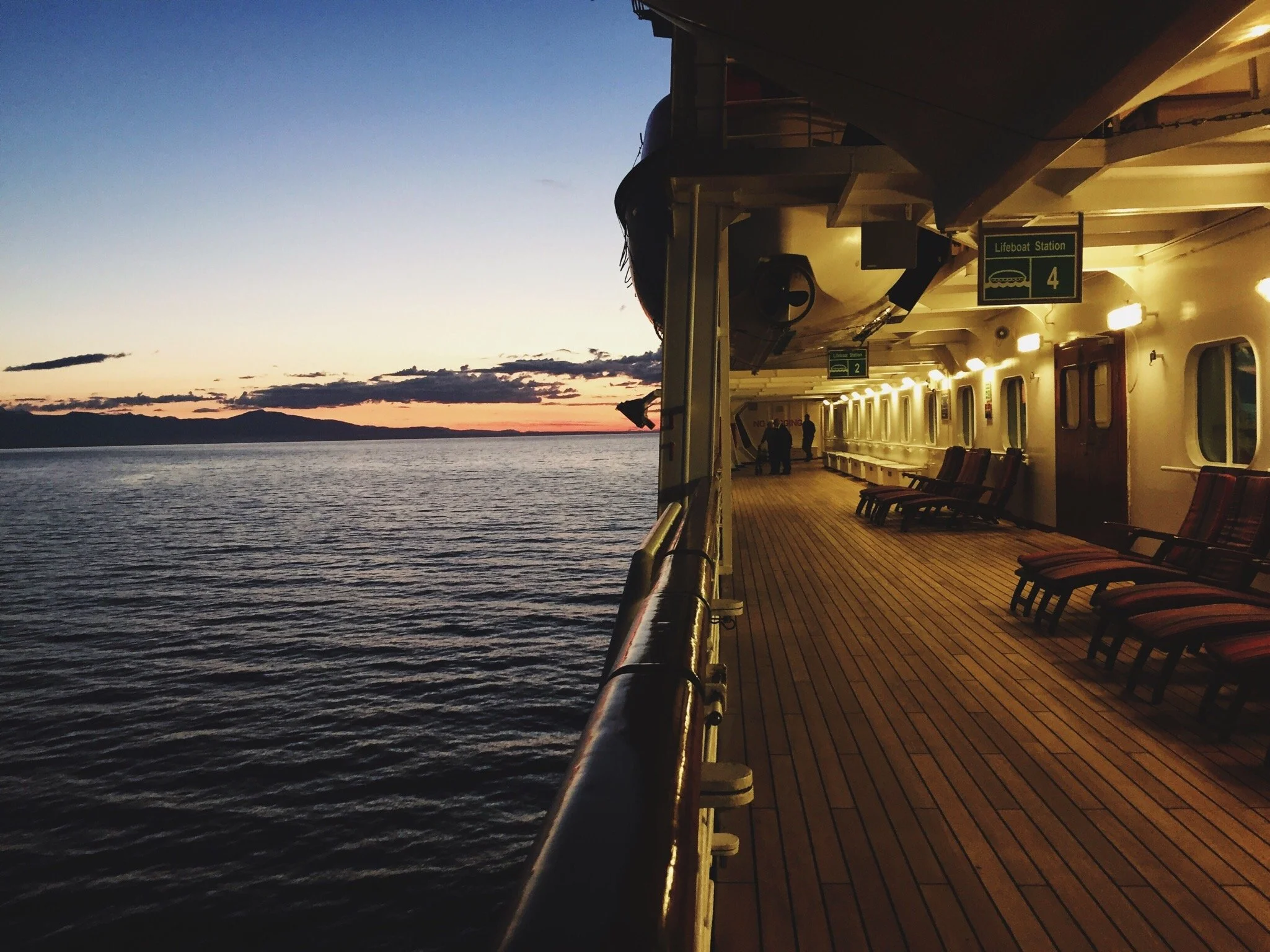
Really?
Before We Sail
Our checklist before bringing folding bikes aboard
• Check the cruise line's current policy. Do not assume that a folding bicycle is permitted simply because it is small enough to fit in your stateroom. Policies change, and cruise lines may handle bicycles and mobility equipment differently.
• Contact the accessibility department well in advance. Explain exactly what you are bringing and why, and how you use it. In our case, that means saying specifically that our mobility devices are Brompton folding bicycles rather than simply asking permission to bring mobility devices.
• Get the approval in writing. Make sure the documentation clearly identifies what has been approved and any conditions that apply, such as storage in the stateroom, and use only ashore.
• Carry a paper copy with you. We also keep the approval electronically, but after one experience in which shipboard security had not received our authorization, we now carry a printed copy where we can reach it easily during embarkation.
• Consider attaching backup copies to the bike cases. We are considering putting two copies of the approval letter in weather-resistant document sleeves and securely attaching them to the outside of each case. A clear zip pouch or sturdy luggage-document sleeve should protect the pages better than an ordinary open plastic sleeve. The attachment must be flat, secure, and clear of handles, wheels, latches, and official baggage tags. We would still carry a separate paper copy ourselves; the case copies are simply an extra safeguard if the cases are separated from us during handling or security processing.
• Bring the approval ashore too. Port rules and cruise-line rules are not necessarily the same. Our experience in Key West taught us that documentation can remain useful after we have left the ship.
• Expect procedures to vary. A ship may have a storage or security system different from the one we expected. We adapt to the ship's procedure.
• Allow extra time and make yourself easy to accommodate. We never want our bicycles to block a corridor, delay a gangway, crowd an elevator, or make another passenger's trip more difficult.
For Holland America specifically, the current published prohibited-items list includes bicycles, while the line's accessibility guidance asks guests to contact its Guest Accessibility Department and submit a Special Requirements Information form as early as possible. HAL recommends submitting the form immediately after booking or at least 45 days before sailing when possible. Its published guidance also says mobility equipment must be securely stored in the guest's stateroom rather than in hallways or elevator lobbies. That combination is precisely why we obtain specific advance authorization rather than assuming our Bromptons will be accepted.
Moving Through the Ship
We try very hard to make our bicycles almost invisible to everyone else.
Our default method is to fold the Brompton, leave the seatpost extended so we can steer it, and cover it with our open-bottom rinko bag. That makes the bike look more like luggage than a bicycle while still allowing us to roll it.
Sometimes it actually makes more sense to unfold the Brompton and roll it on its own 16-inch wheels. An unfolded Brompton is long and narrow. A folded Brompton is short and comparatively wide. In a narrow ship corridor, the unfolded bike can therefore have a smaller practical footprint, as long as the pedals are folded out of the way.
Whichever configuration we use, consideration for other passengers comes first.
We stay to one side in corridors. We pay attention at corners and doorways. And we are especially careful around elevators.
If an elevator looks even half full, we wait for the next one.
Sometimes John and I take separate elevators rather than trying to put two bicycles into one. There is no reason our desire to go cycling should inconvenience any other passenger.
In our stateroom, we make sure the bikes are well out of the way, both for us moving about the cabin and for the stewards who look after it. We usually bring several disposable dog “pee pads” to park the bikes on and protect the carpet. Sadly, we have reason to have a lot of them around the house (Looking at you, Josephine!).
Maybe it does not need to be said, but: do not use the room towels to wipe down your bike. Bring a cleaning cloth of your own, some paper towels, or an old T-shirt.
We want to make it easy for them to welcome us and our bikes back.
Going Ashore
The gangway deserves particular care.
We do not try to squeeze past anyone or join a tightly packed group. We wait until we have enough room to maneuver safely.
Going down the gangway, we firmly guide the bicycle with one hand and hold the railing with the other. Once ashore, there is usually someplace nearby where we can step out of the traffic flow, uncover or unfold the bikes, attach our gear, and get ready to ride. Sometimes the crew members manning the gangway offer to help, for which we are grateful and make sure to let them know how much we appreciate it.
And then we are off.
This is one of the reasons Bromptons work so beautifully for cruise travel. Instead of being limited to the immediate port area, a shuttle bus, or an organized excursion, suddenly we have our own transportation.
The world gets bigger again.
Coming Back Aboard
Returning to the ship is slightly more involved.
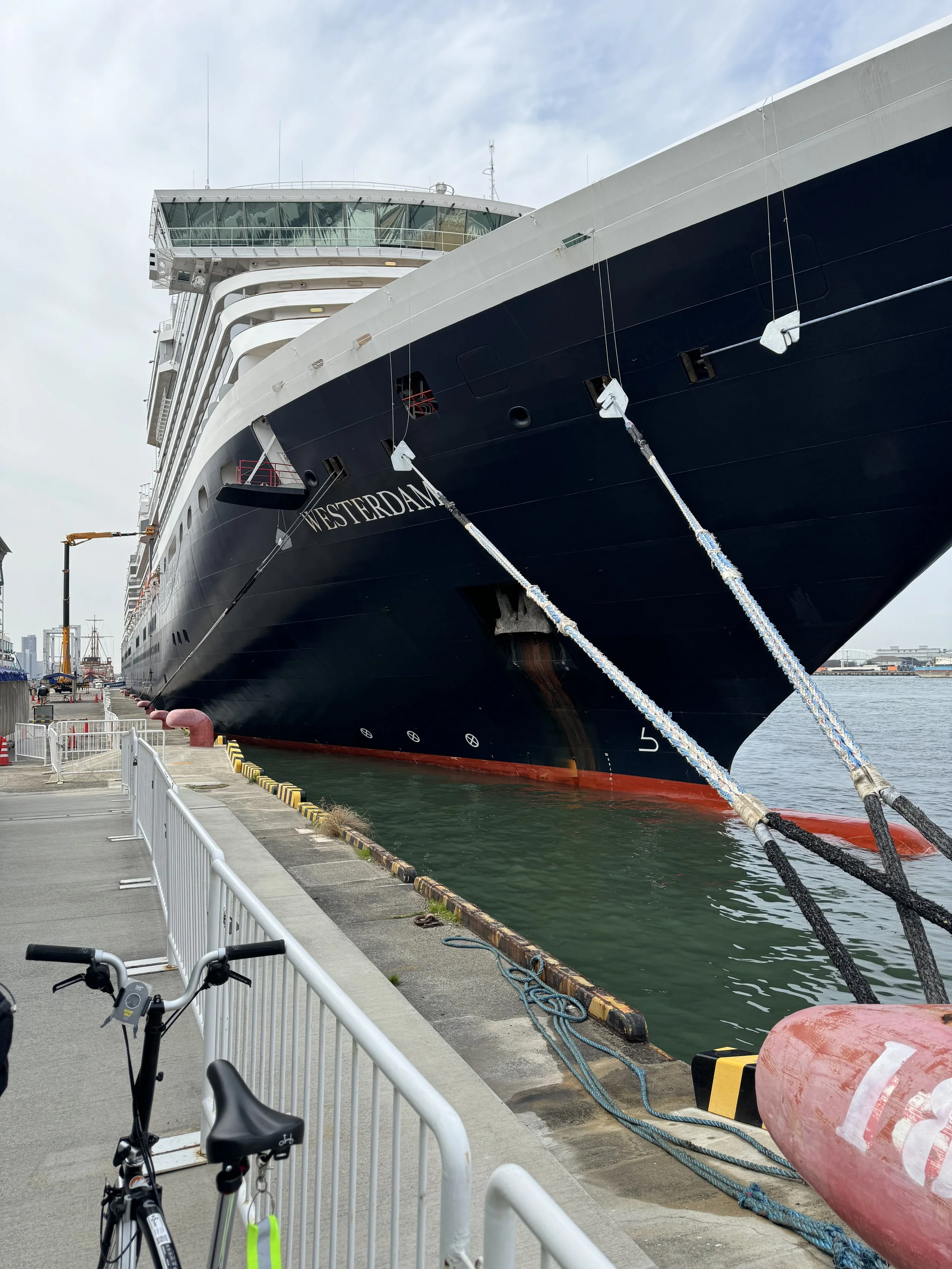
At most ports there is some level of shoreside security where we first show our ship cards. Once we have passed that checkpoint, we find a place near - but not in the way of - the gangway and reorganize.
Everything detachable comes off the bicycles: packs, water-bottle holders, and anything else we have added for the day. Those items go into our backpacks. We fold the pedals and roll the bicycles up the gangway, again leaving plenty of room for other passengers.
Once aboard, we scan our ship cards and go through ship security. Our bags and other belongings go through the X-ray machine.
On every cruise line we have sailed, ship security personnel have been extraordinarily kind about our Bromptons. On our first return aboard, we often work with the security staff to establish a procedure. They generally take the bicycles from us while we walk through the scanner and hand them back on the other side.
We make a point of thanking them. They have a serious job to do, and making their job easier is part of making this arrangement work.
Then we repeat our elevator routine: wait for plenty of room, minimize our footprint, and sometimes travel separately.
Different Ships, Different Procedures
The overall process has been similar on Holland America, Royal Caribbean, MSC, and Celebrity, but not identical.
On the MSC Bellissima, for example, security preferred to keep our Bromptons in a locked storage area near the security station rather than having us keep them in our stateroom.
That sounded potentially cumbersome.
It wasn't.
When we wanted to ride, we went down to the gangway and told security we were taking the bicycles ashore. Within a few minutes they retrieved them for us. When we returned, the bikes went back into secure storage.
The system was effortless.
That experience taught us an important lesson: do not assume your preferred arrangement is the only arrangement that will work. The staff on the ship want us to have a good time, but they also have operational constraints and safety protocols. Do what they say.
When the Paperwork Did Not Follow Us
We have had only two genuinely unpleasant experiences involving our Bromptons on cruise trips.
The first was on Holland America.
We had contacted accessibility services well in advance, explained our situation, and received permission to bring the bicycles aboard as mobility devices.
Unfortunately, someone at corporate headquarters apparently failed to forward the authorization to shipboard security.
Security therefore saw two prohibited bicycles.
We saw two mobility devices we had specifically been authorized to bring aboard.
We had the email from accessibility services on my phone, but its wording referred to approval of our mobility devices without specifically identifying those devices as bicycles. We knew what had been approved. Shipboard security — understandably — could not know that.
Eventually the issue went up the chain of command. Someone aboard contacted accessibility services, obtained confirmation of the authorization, and the bicycles were released to us after 24 hours.
Everything ultimately worked out.
But the experience was frustrating and, frankly, embarrassing.
We love Holland America and continue to sail with them, but we never want to repeat that experience.
So now we carry a paper copy of the actual permission letter with us.
Not somewhere in our luggage. Not merely buried in an email account. With us.
Sometimes old-fashioned paper is remarkably useful.
Permission to Go Ashore
Permission to bring the bikes aboard is only part of the equation. We also need to know whether the port authorities will allow us to take them ashore. Approval from the cruise line does not necessarily settle that question.
When we cruised in Japan, the authorities at each port gave us permission individually to bring the bikes ashore, coordinated through our concierge. On the same cruise, Shanghai explicitly prohibited bicycles ashore; there was even a sign at the port entrance from the ship. We respected that restriction. These were the arrangements on that particular trip, so we check again for each itinerary.
The Very Strange Case of Key West
Our other negative experience was not really a cruise-line problem at all.
We were aboard a Celebrity cruise that stopped for the day in Key West. After leaving the ship, we were standing near the port arranging our equipment and getting the Bromptons ready to ride when a gentleman from port security approached us.
He was perfectly polite, but told us that the port authority had reminded security that passengers were not permitted to bring items ashore other than a small bag - and specifically that bicycles were not permitted.
We were baffled. Why would a port care whether we brought our own bicycles ashore?
We were told that bicycle-rental concessionaires operated nearby and did not want to lose rental business.
Fortunately, once again, we had documentation on my phone showing that the cruise line had approved our Bromptons as mobility devices.
We showed the documentation and explained why we used the bikes as mobility devices.
After that discussion, we were allowed to take them ashore.
There was a rather grumpy telephone conversation somewhere in the process, but we were allowed to proceed.
We rode away.
We still are not entirely sure what to make of that episode. And Key West is not high on our list of places to revisit.
What We Have Learned
• Ask first. Never assume that a folding bicycle is permitted simply because it fits in your cabin.
• Explain exactly what the device is. The words “mobility device” may not be sufficiently helpful if shipboard security does not know the device is a bicycle.
• Get approval in writing and make sure the letter identifies Brompton folding bicycles specifically.
• Carry a printed copy of the approval with you and consider securing backup copies to the outside of the cases in weather-resistant document sleeves.
• Check shore access as well as ship approval. Ask the cruise line to help confirm port requirements before planning a ride.
• Work with security rather than around them.
• Keep bicycles and equipment in your stateroom or wherever the ship directs you to store them.
• Never block corridors, gangways, elevators, or other passengers. Be considerate!
• Be especially considerate of passengers using wheelchairs, walkers, scooters, or other mobility equipment.
• Allow extra time. There is almost always another elevator and another moment to walk up the gangway.
• Thank the crew. The security officers who have helped us over the years have been overwhelmingly professional, competent, and kind.
Most of all, bringing a Brompton aboard a ship under an accessibility accommodation depends on trust. We want the crew member who encounters our bicycles to think, “Those people make this easy.”
If those of us who use unconventional mobility devices handle them carefully and responsibly, perhaps it becomes a little easier for the next traveler who needs something “outside the box.”