
Trains, Buses, Ferries
Maibara-Maihara Shinkansen, Japan. Getting the bikes and our luggage on and off was tough, but wow! What fun to ride!
A folded Brompton makes most forms of public transportation remarkably straightforward. Our approach is simple: check the local rules, keep the bike out of everyone’s way, and stay flexible when the journey becomes more trouble than it is worth.
Trains, Buses, Subways, and Passenger Ferries
One of the great advantages of a Brompton is that public transportation usually becomes much simpler once the bike is folded.
We’ve taken ours on trains, subways, buses, and passenger ferries in a number of countries. Most of the time, the process is remarkably uneventful: fold the bike, keep it out of everyone’s way, and take it with you.
Rules vary. Some systems treat a folded bicycle essentially as luggage, while others may require it to be covered or placed in a bag. Before traveling, we check the rules for that particular train, transit system, or ferry rather than assuming that what worked somewhere else will work there.
Crowds are often more important than the official rules. A folded Brompton is small, but it is still a fairly substantial object when you are standing in a packed subway car or trying to get onto a busy train. If things are crowded, we try to position ourselves where the bikes will inconvenience other passengers as little as possible.
Buying tickets can occasionally be the hardest part. In Keelung, Taiwan, for example, we had an unexpectedly difficult time communicating at the station ticket counter and were very grateful when another cruise passenger who spoke some Mandarin helped us. Experiences like that are good reminders that even with translation apps, sometimes you simply need to ask for help.
And sometimes the best transportation decision is to abandon the original plan. If we’re tired, running late, carrying too much, or simply becoming frustrated, we call a taxi or Uber. There is no prize for completing every journey by public transportation.
Vehicle Ferries
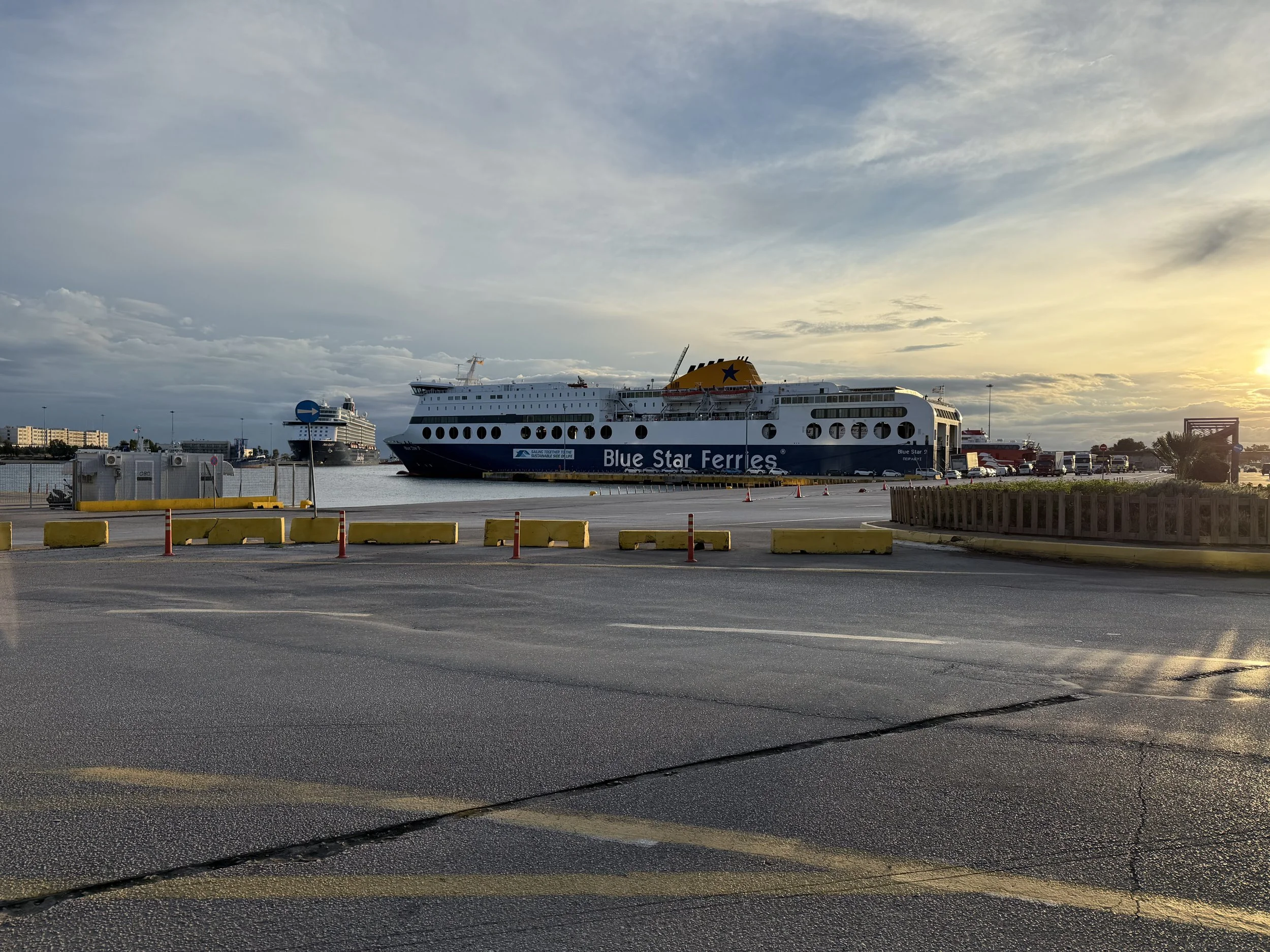
Blue Star 2, which took us overnight from Pireaus to Patmos, Greece.
Vehicle ferries are different because they may allow you to ride the bicycle aboard rather than folding it.
That can make them one of the easiest forms of transportation with a bike. We generally follow the directions given to cyclists, ride or walk onto the vehicle deck, and leave the bikes wherever the crew directs us. On some ferries we’ve simply secured them against a railing or other designated area.
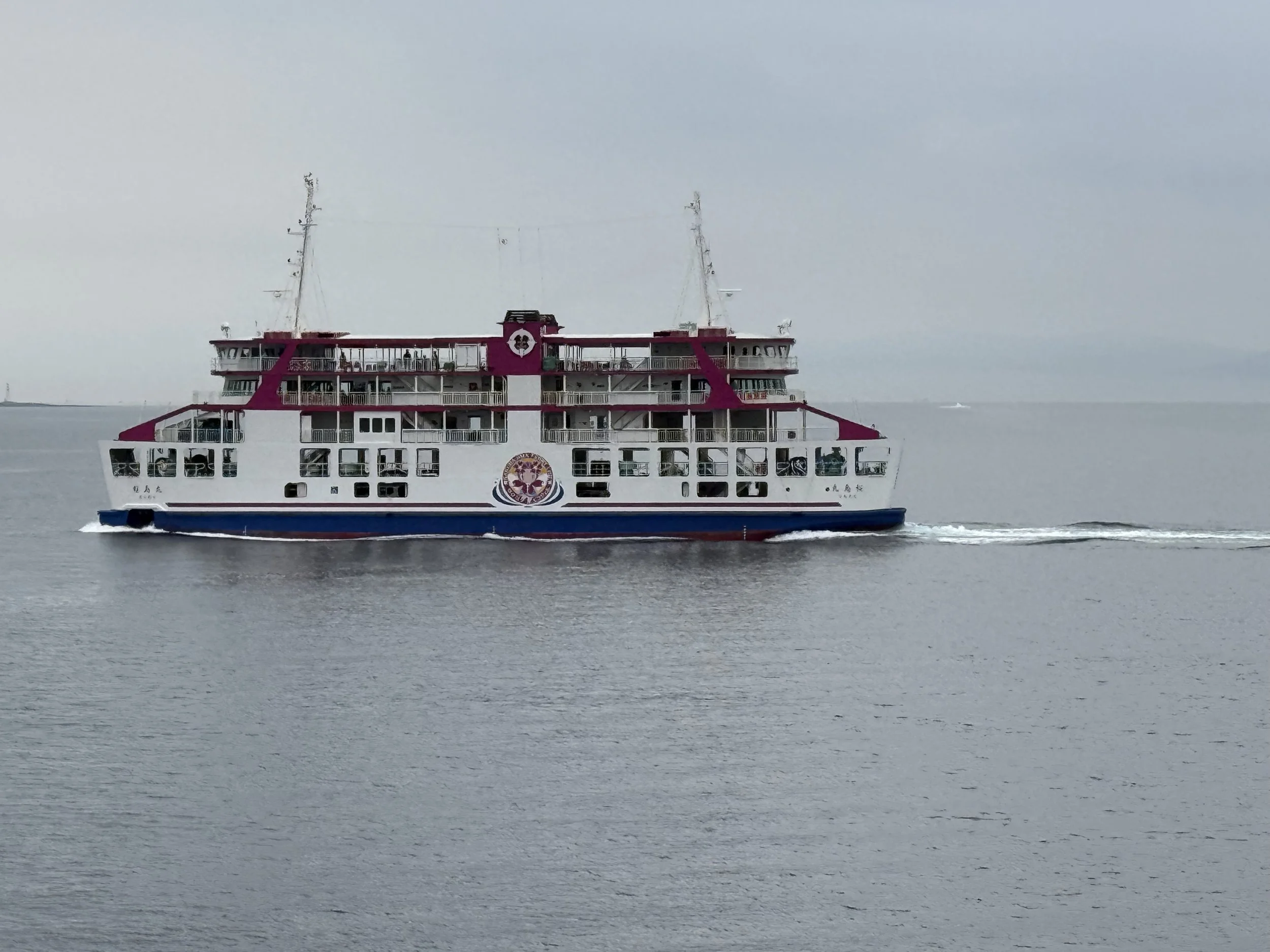
The ferry from Kagoshima to Sakurajima, Japan
As always, procedures vary from one ferry operator to another, so we check before traveling. But compared with getting bicycles onto airplanes—or even some trains—vehicle ferries can be wonderfully uncomplicated..