
Talinn, Estonia
Talinn, Estonia
July 27, 2022
Sometimes the best days begin with only a vague idea of where you're going.
That was certainly true in Tallinn.
We arrived aboard Royal Caribbean's “Voyager of the Seas,” a ship we really enjoyed. Our stateroom was right at the bow, with an extraordinary view straight ahead over the ship, so we had watched Tallinn appear in front of us as we came into port.
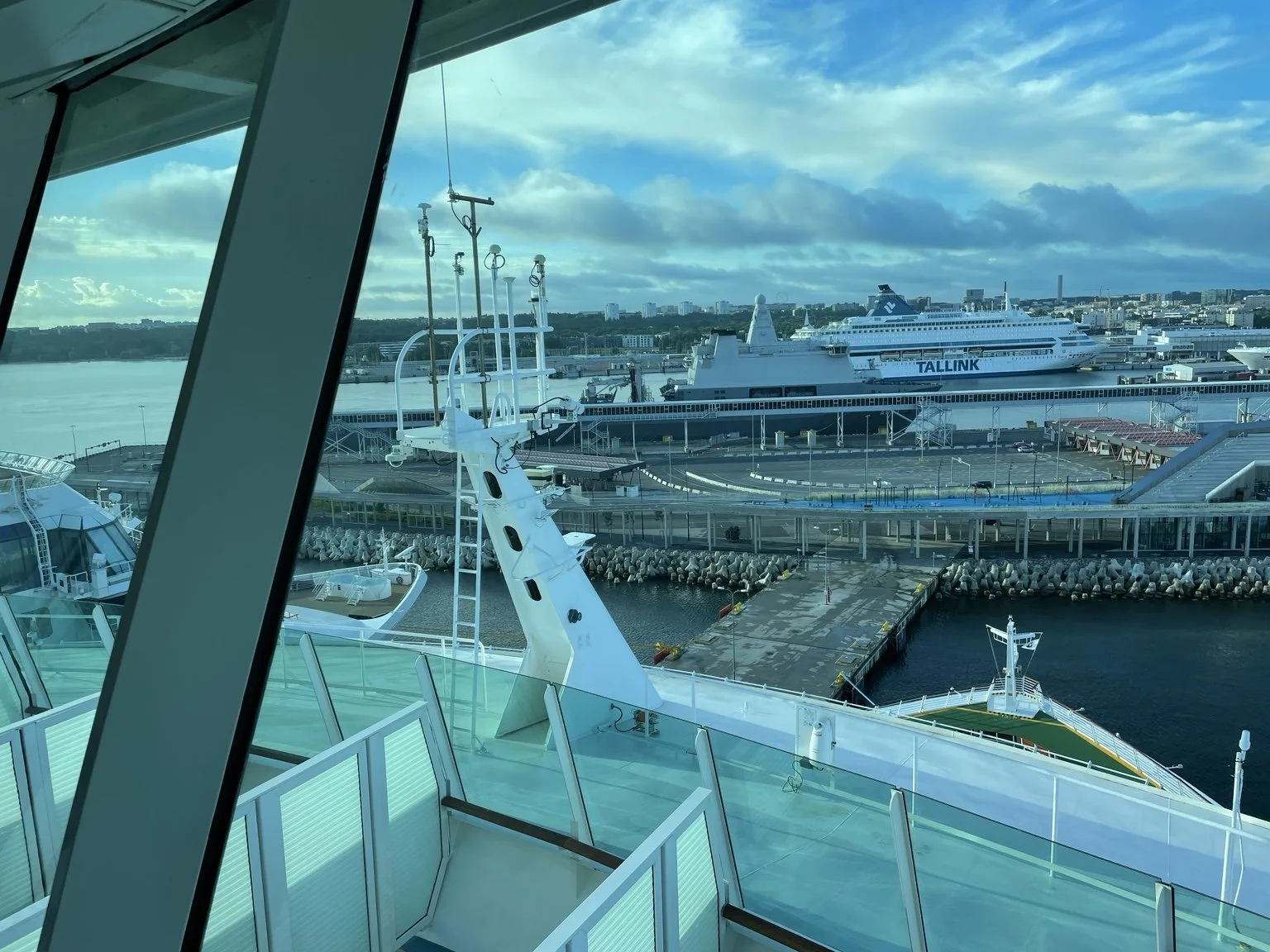
Talinn before the tourists
We got ourselves and our Bromptons off the ship fairly early. We knew two things: we wanted to ride through Tallinn's Old Town, and I had read somewhere that there was a bike route running eastward along the Baltic coast toward the Tallinn TV Tower.
That was our entire plan.
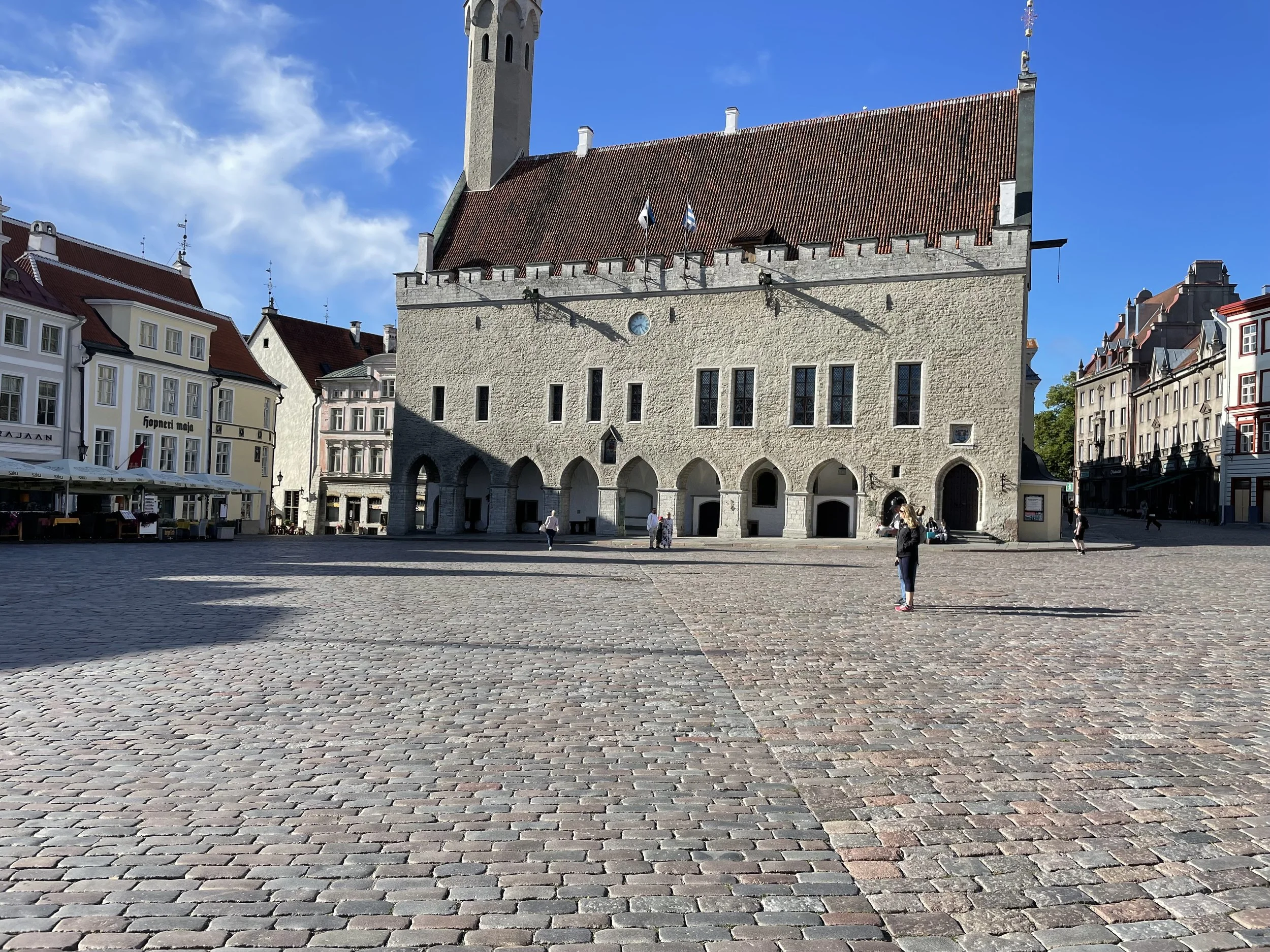
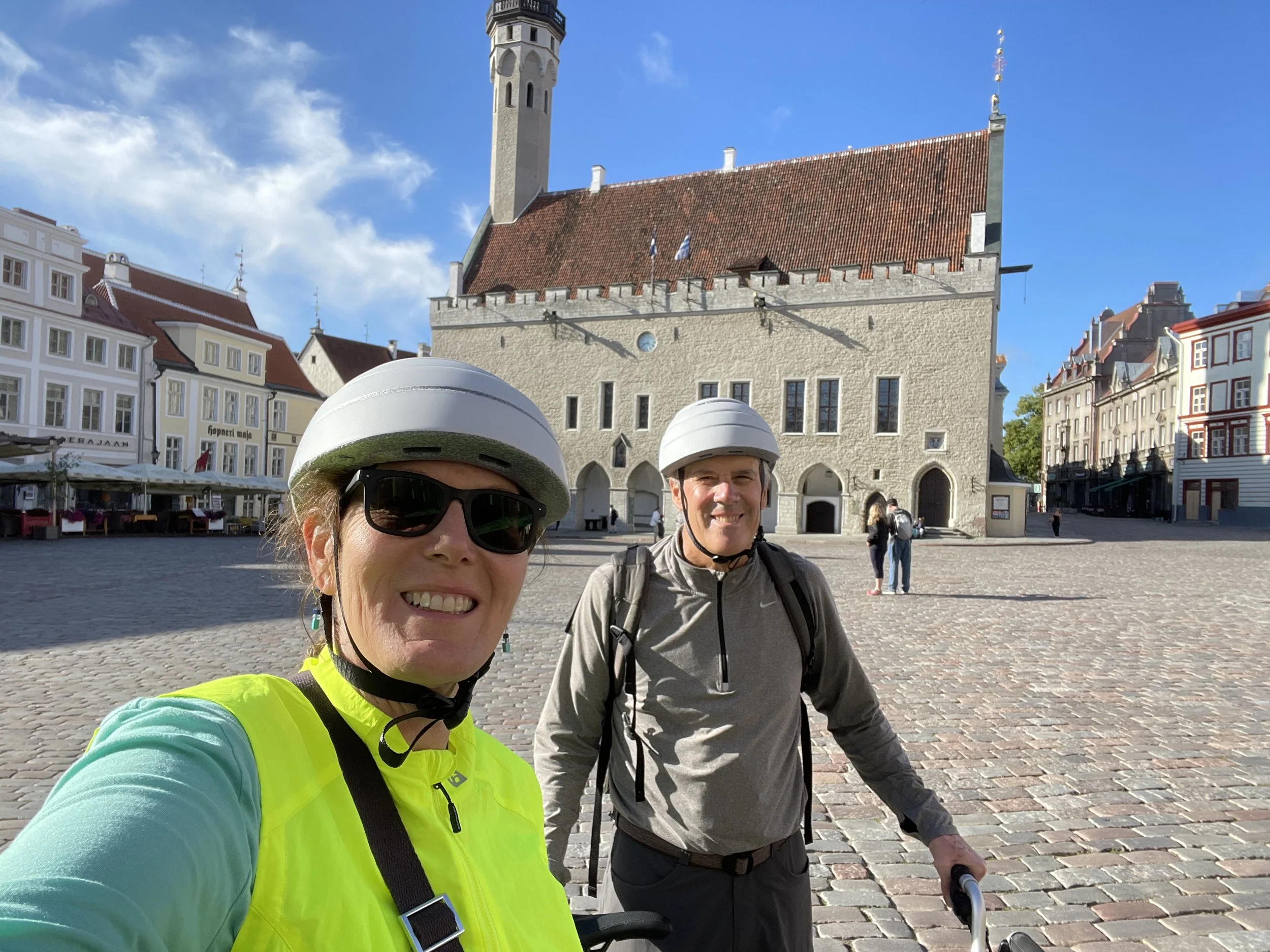
It was around 8:00 in the morning when we rode into Tallinn's Old Town, and the streets were wonderfully empty.
Tallinn is famous for its beautifully preserved medieval center, but this early we didn't have to negotiate crowds of tourists. We wandered on the Bromptons along cobblestone streets between pastel buildings, going wherever something looked interesting.
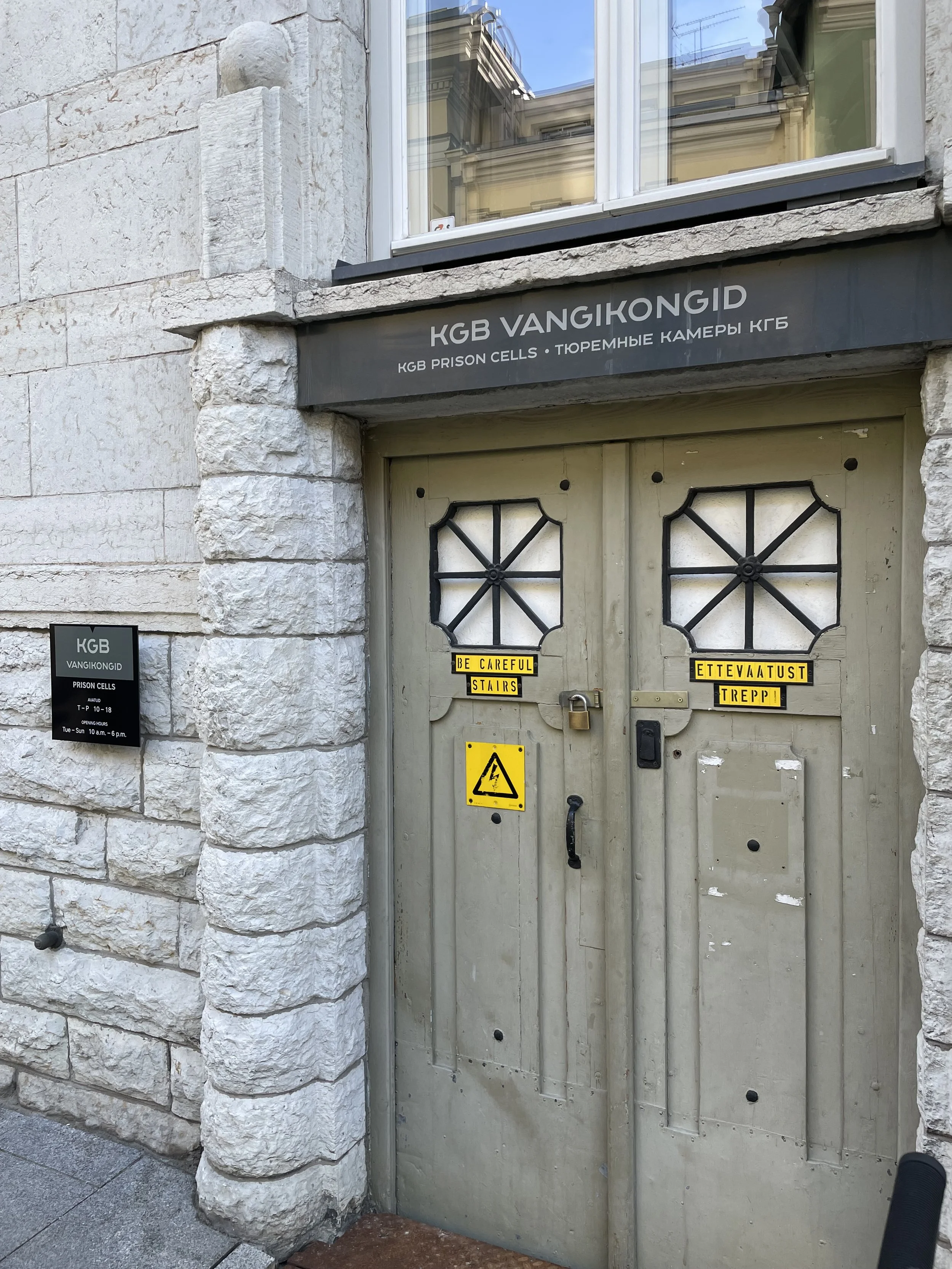
People suspected of opposing the Soviet occupation were imprisoned and interrogated in the building's basement. Today the cells are preserved as a museum associated with Vabamu Museum of Occupations and Freedom.
We didn't go inside. We were on bicycles and had a whole city in front of us.
But simply passing the entrance was chilling.
Very quickly, though, the morning became something more than sightseeing.
On Pikk Street we passed Pikk 59, where the KGB once maintained prison and interrogation cells.
We Turned a Corner — and Found Russia
A little farther along we rode onto another narrow cobblestone street and suddenly began seeing flags, posters, photographs, homemade signs and protest banners.
At first we didn't understand what we were seeing.
Then we saw the Russian flag hanging from the building.
We had happened upon the Russian Embassy.
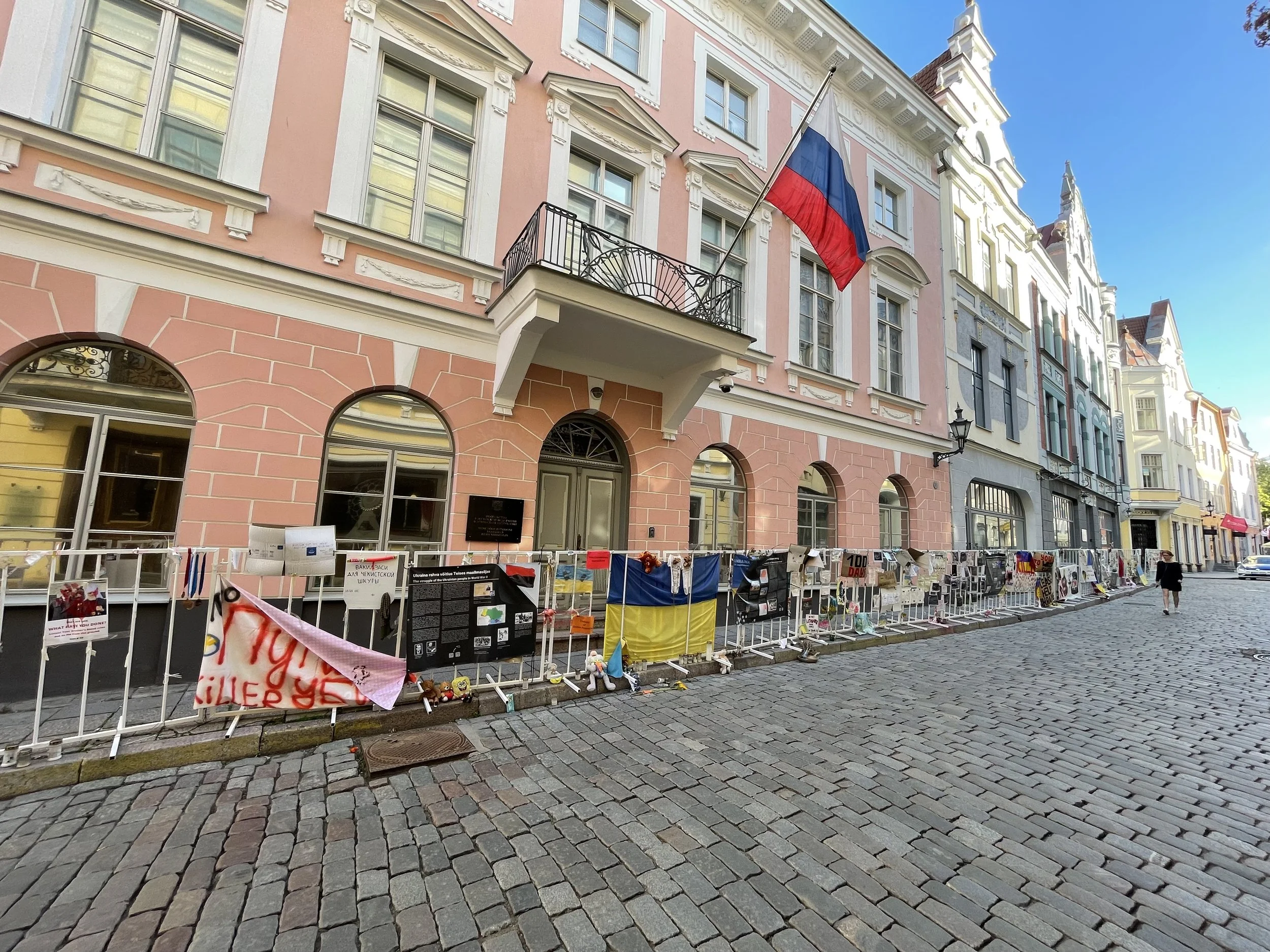
This was July 2022, just a few months after Russia's invasion of Ukraine.
The sidewalk barriers outside the embassy were covered with expressions of grief, fury, and solidarity with Ukraine.
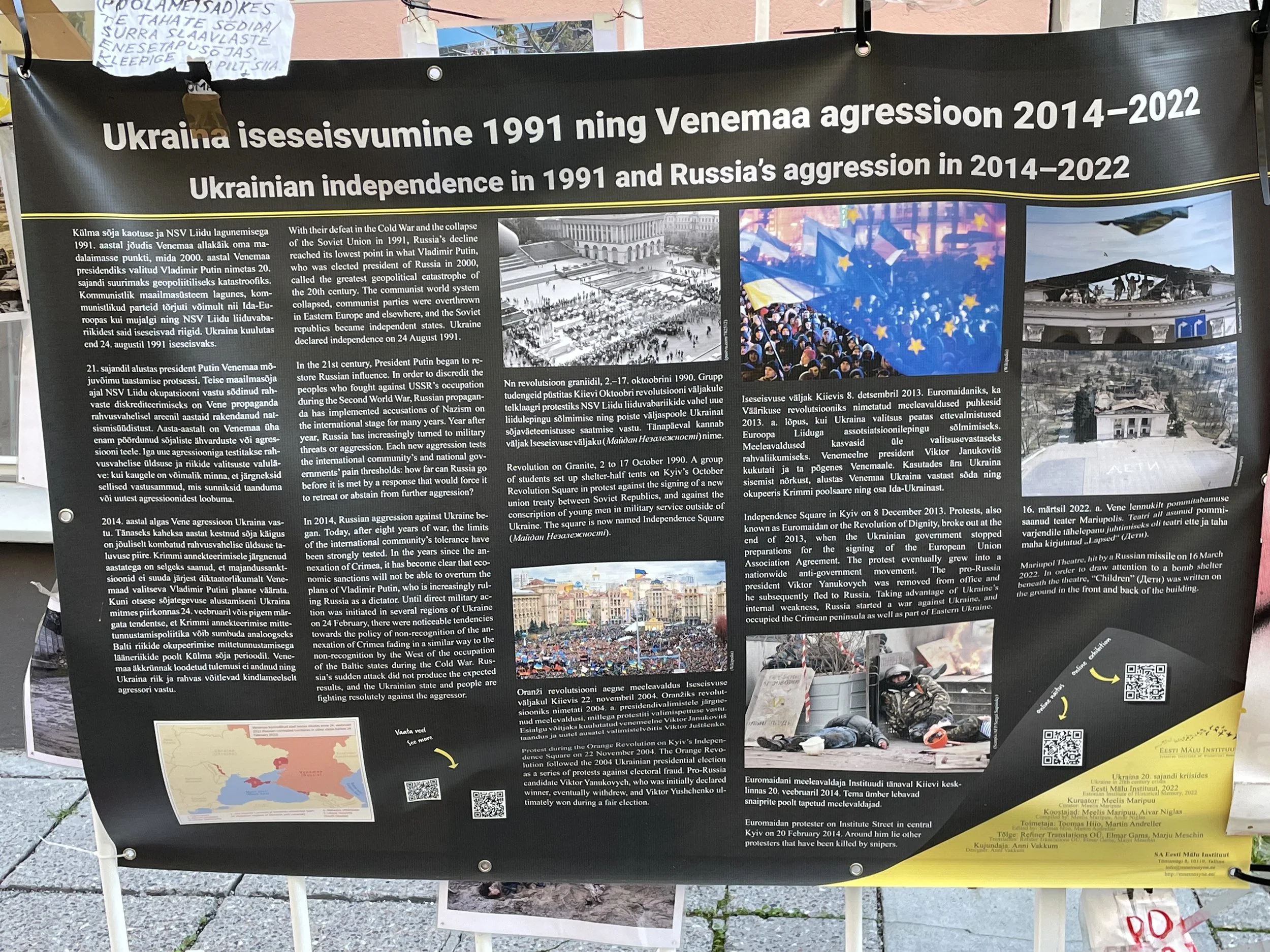
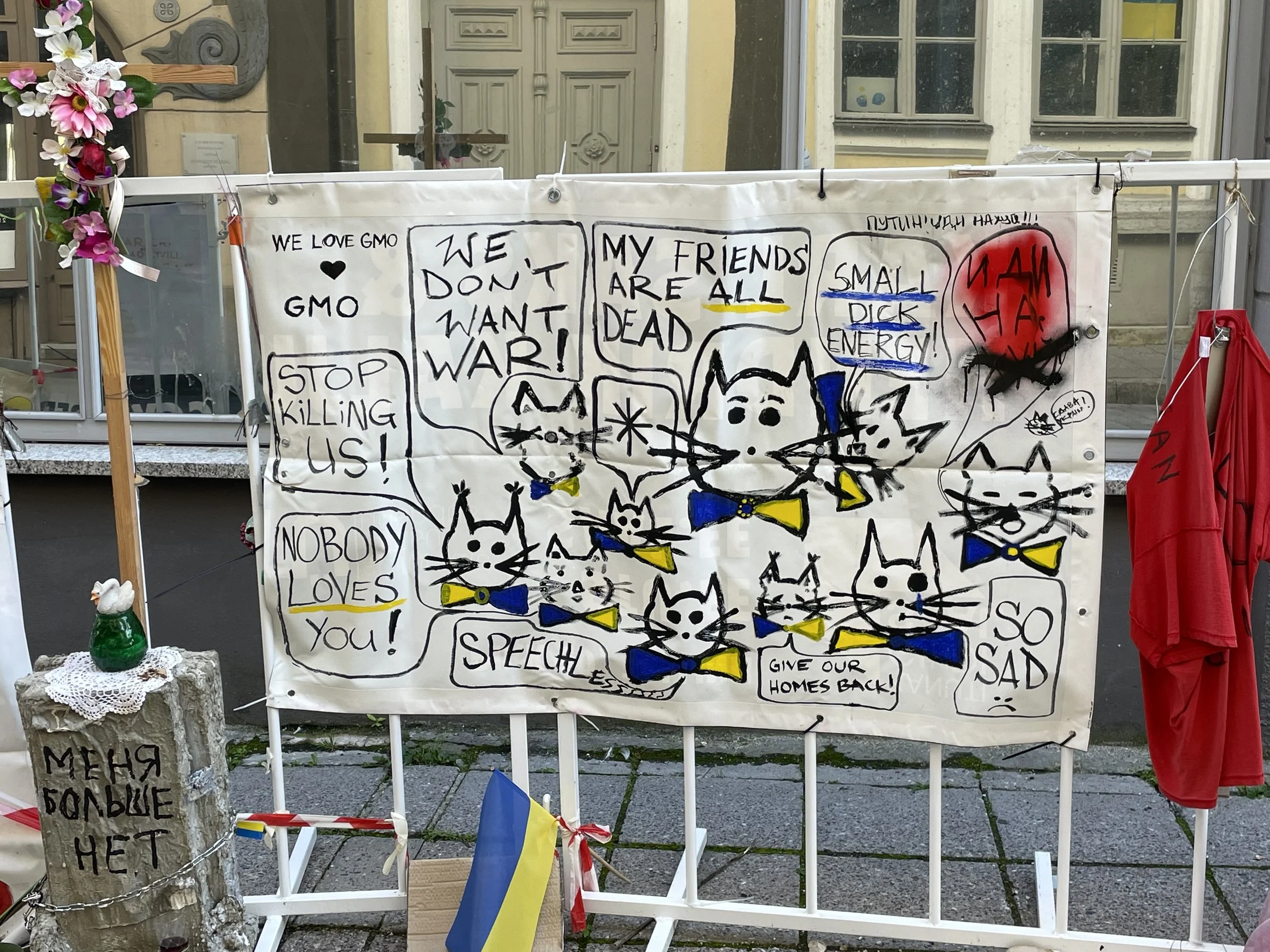
Others were obviously handmade.
There were Ukrainian flags, flowers and signs pleading, Please help Ukraine.
Another simply said, Stop killing people.
Some were professionally printed exhibits explaining Soviet repression and Russian aggression.
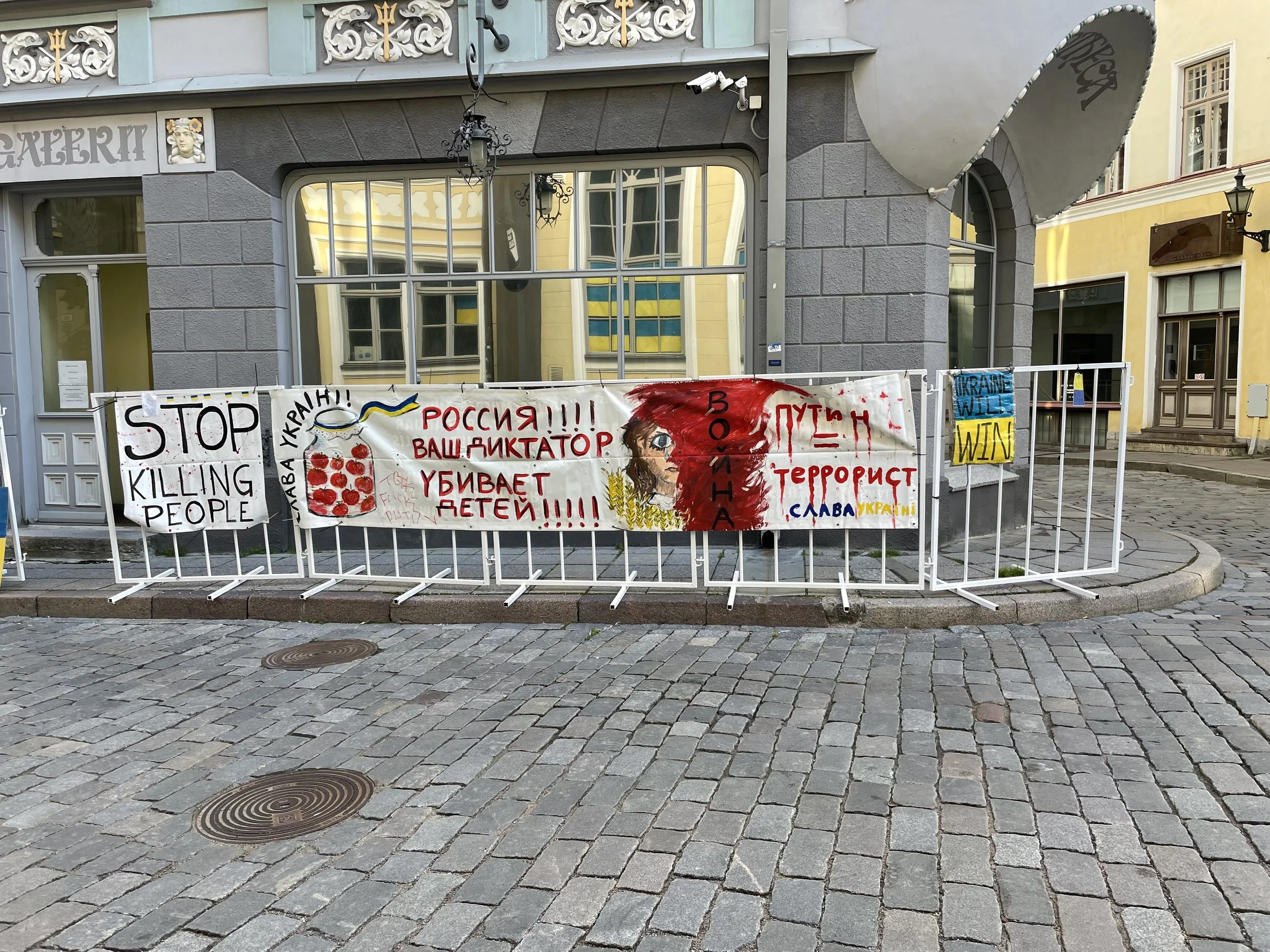
At the end of the street sat a police car with two officers inside, quietly watching.
Estonians’ understanding of Russian occupation is fresh and visceral. Soviet forces occupied and annexed Estonia in 1940; decades of repression, executions, deportations and political control followed. Estonia did not restore its independence until August 1991 as the Soviet Union finally collapsed.
And here we were, only thirty-one years later, standing outside the Russian Embassy while Russia was once again trying to destroy a neighboring country.
For Estonia, Ukraine is not an abstract foreign-policy issue. It’s real and threatening.
Eventually we rode on.
Out of the Cobblestones and Onto the Red Bike Lanes
We crossed Town Hall Square and began making our way east out of the historic center.
And then we encountered something we would come to recognize all over bicycle-friendly parts of Europe: the red bike lane.
We loved it.
Instead of squeezing along the edge of traffic and hoping drivers noticed us, suddenly there was a conspicuous piece of roadway saying, in effect: Bicycles belong here.
For two Americans still new to taking bicycles around European cities, this felt luxurious.
The city began opening up as we headed toward the coast.
Along the Baltic
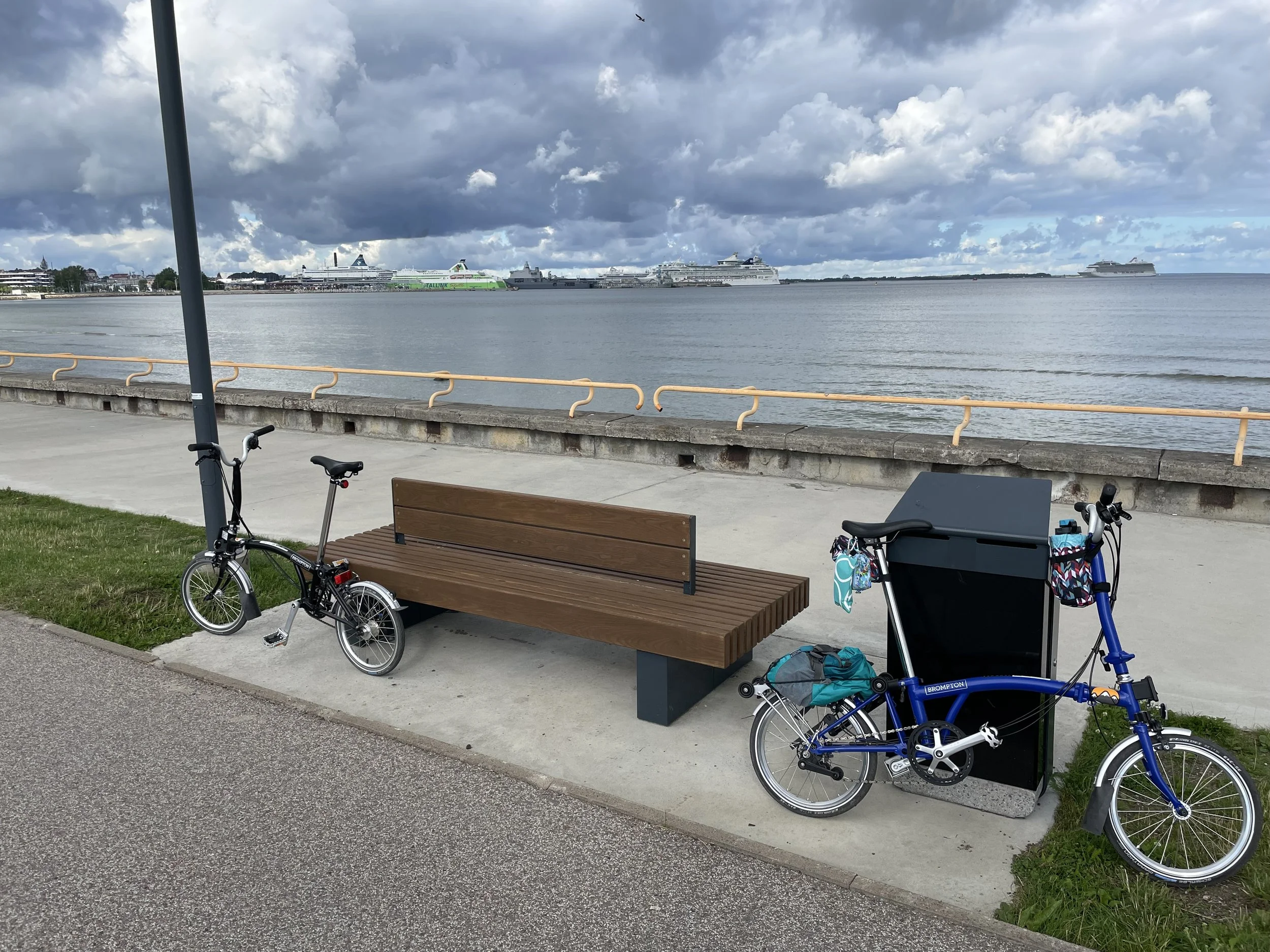
East of central Tallinn, we reached the long promenade along Tallinn Bay.
The city was behind us. The Baltic was beside us. The road and bicycle path stretched ahead.
Across the water we could look back toward the harbor and see our cruise ship and the big ferries that connect Tallinn with Helsinki, Stockholm, and other Baltic ports.
I especially love this photograph because it captures one of the things that makes cruising with folding bicycles so much fun.
Our ship was over there.
Our bicycles were here.
And everything in between was ours to explore.
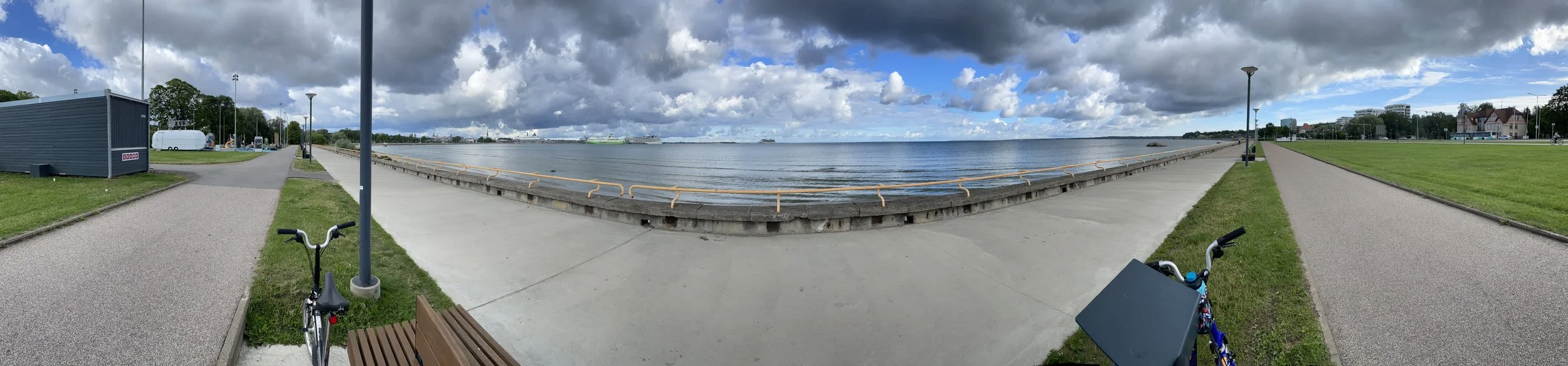
We followed the coast for several miles through Pirita. The riding was easy, flat, and wonderfully separated from traffic.
Then the route turned inland, and our destination loomed ahead.
The TV Tower
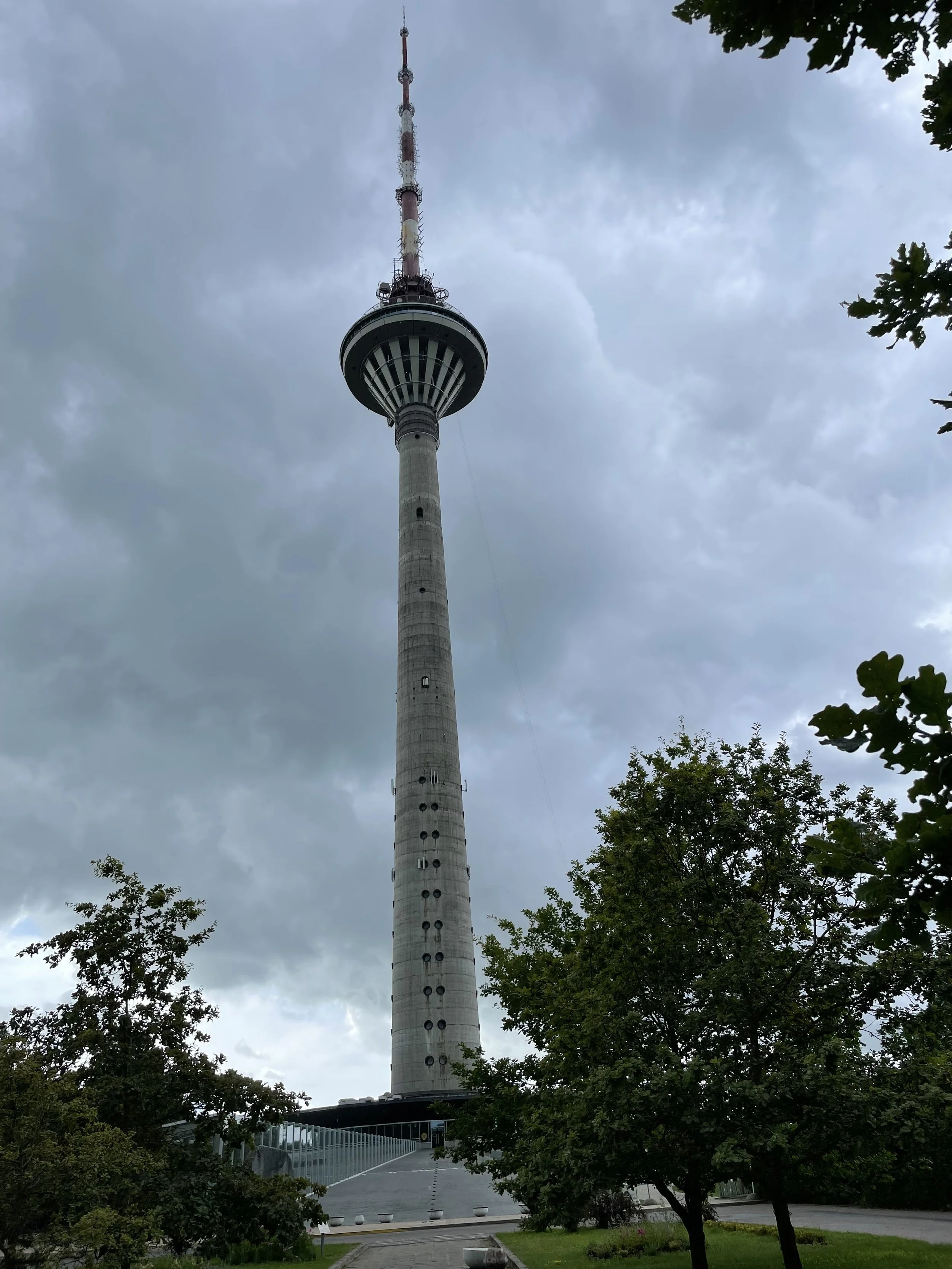
The Tallinn TV Tower is hard to miss. At 314 meters — just over 1,000 feet — it rises dramatically above the landscape.
The approach changed completely from the seaside riding. We turned south and inland, climbing gradually through peaceful forest.
We knew the TV Tower was an interesting destination. What we hadn't fully appreciated was how important it is to the story of modern Estonia’s freedom.
In August 1991, hard-line Soviet leaders attempted a coup in Moscow. Estonia's Supreme Council declared the restoration of the country's independence just before midnight on August 20.
In the early hours of August 21, Soviet airborne troops were dispatched to seize strategic sites in Estonia including the Tallinn TV Tower. At stake was communication with the Estonian people and the outside world.
Hundreds of ordinary Estonians climbed the hill and put themselves between the Soviet troops and the tower. Inside the tower four brave patriots barricaded themselves, continuing to broadcast information. They were committed to keeping the communication center from Soviet hands.
Ironically, the Soviet troops ultimately left when the tower broadcast an update from Finland that the coup in Russia was failing; their mission became pointless and they left without bloodshed.
The television tower remained in Estonian hands.
And so this futuristic concrete tower in the forest isn't merely a broadcast structure; it’s a symbol of Estonia's restored independence.
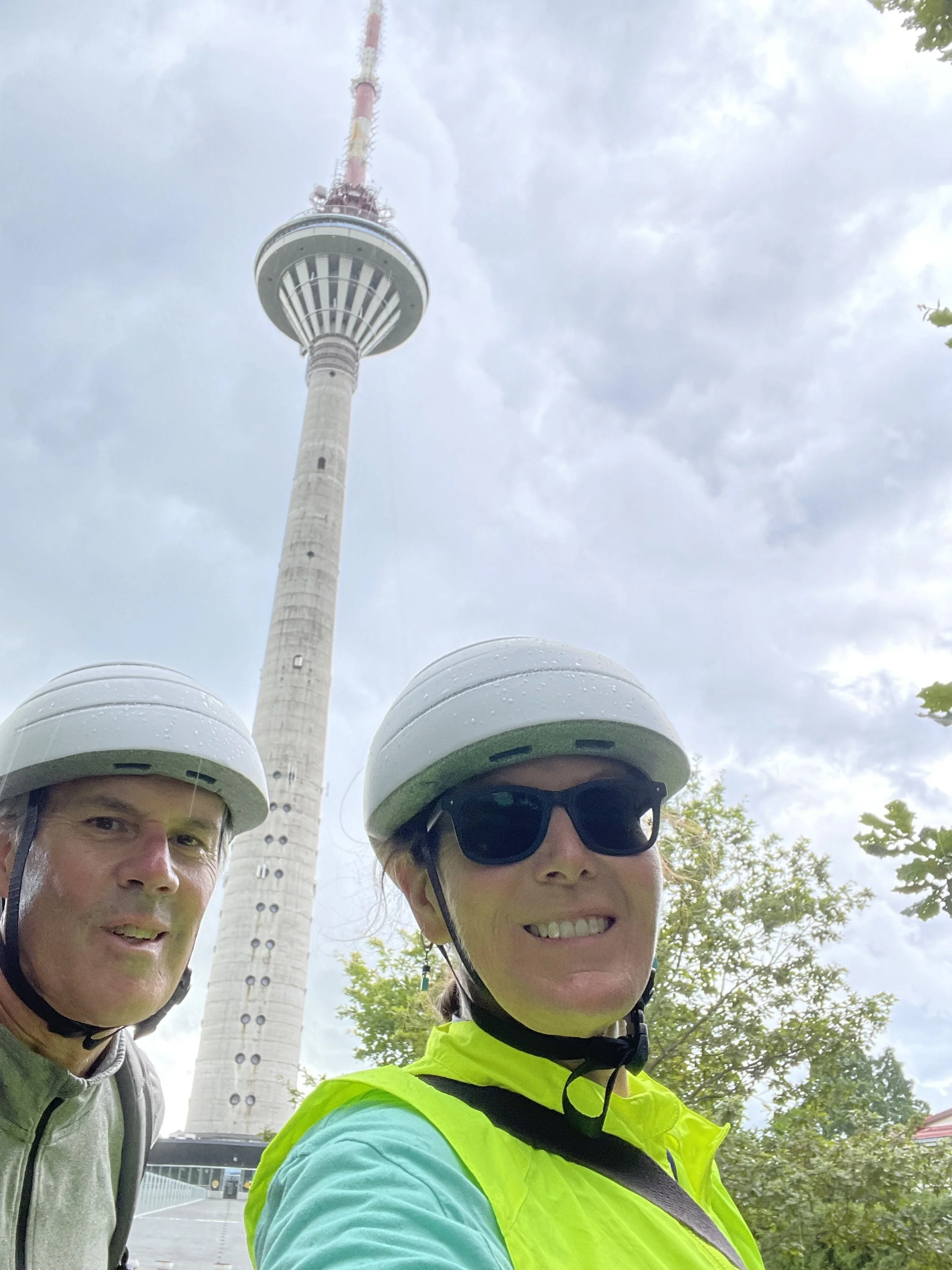
The Bromptons performed like the quality machines that they are.
The route eventually dropped toward the Pirita River, and the forest changed. It became denser and wetter, mysterious and forbidding.
We crossed bridges and followed narrow roads and paths. There was a large manor house hidden behind walls and vegetation, forlorn and abandoned.
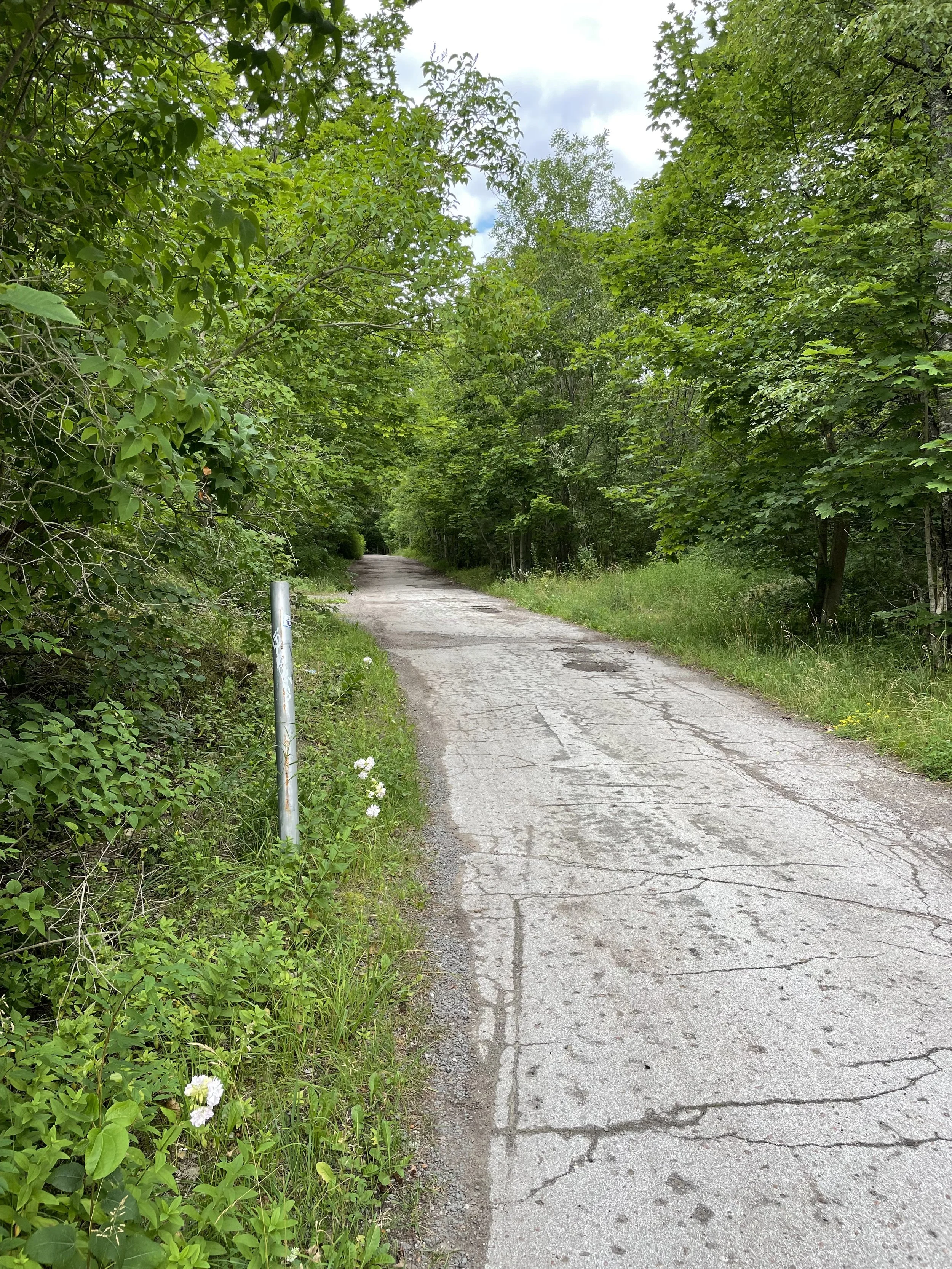
We had absolutely no idea what had happened here.
Then we found a sign.
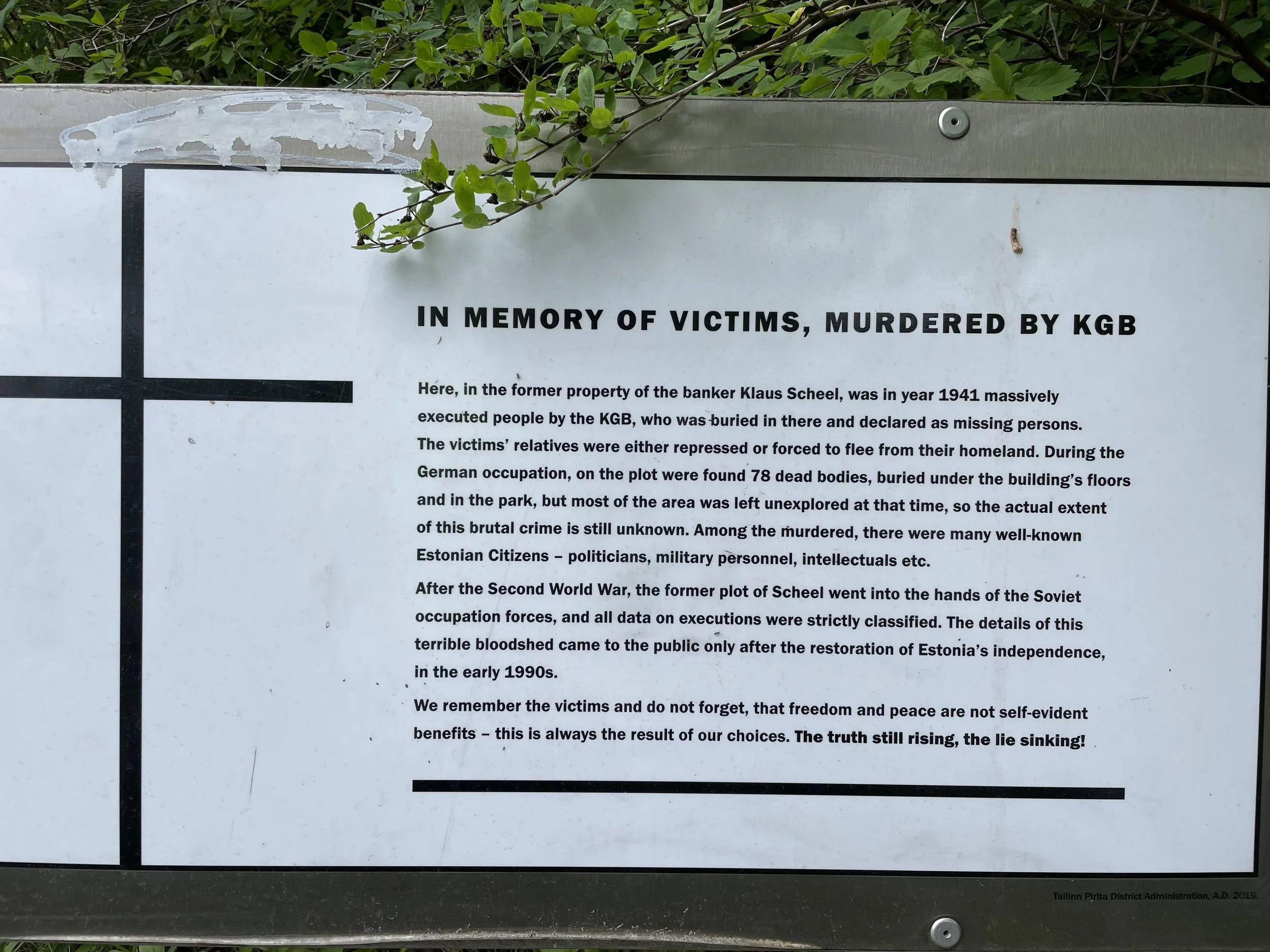
This property had once belonged to the banker Klaus Scheel.
In 1941, people were executed there by the Soviet NKVD/KGB. Seventy-eight bodies were discovered beneath floorboards and on the grounds. The property was not fully investigated so the complete number of victims remains unknown.
Into The Woods
This was where the ride became an adventure.
As we headed back, we left the main route and headed west on unpaved trails through beautiful pine forest. Google Maps showed bike paths, so we took a chance.
People had been murdered and hidden beneath the floors.
Suddenly the spooky forest made sense.
“We remember the victims and do not forget, that freedom and peace are not self-evident benefits – this is always the result of our choices. The truth still rising, the lie sinking!”
After a time we rode on.
The memorial calls this corridor “The Journey.”
It is deliberately oppressive — enormous dark walls closing in on a narrow stone passageway engraved with names.
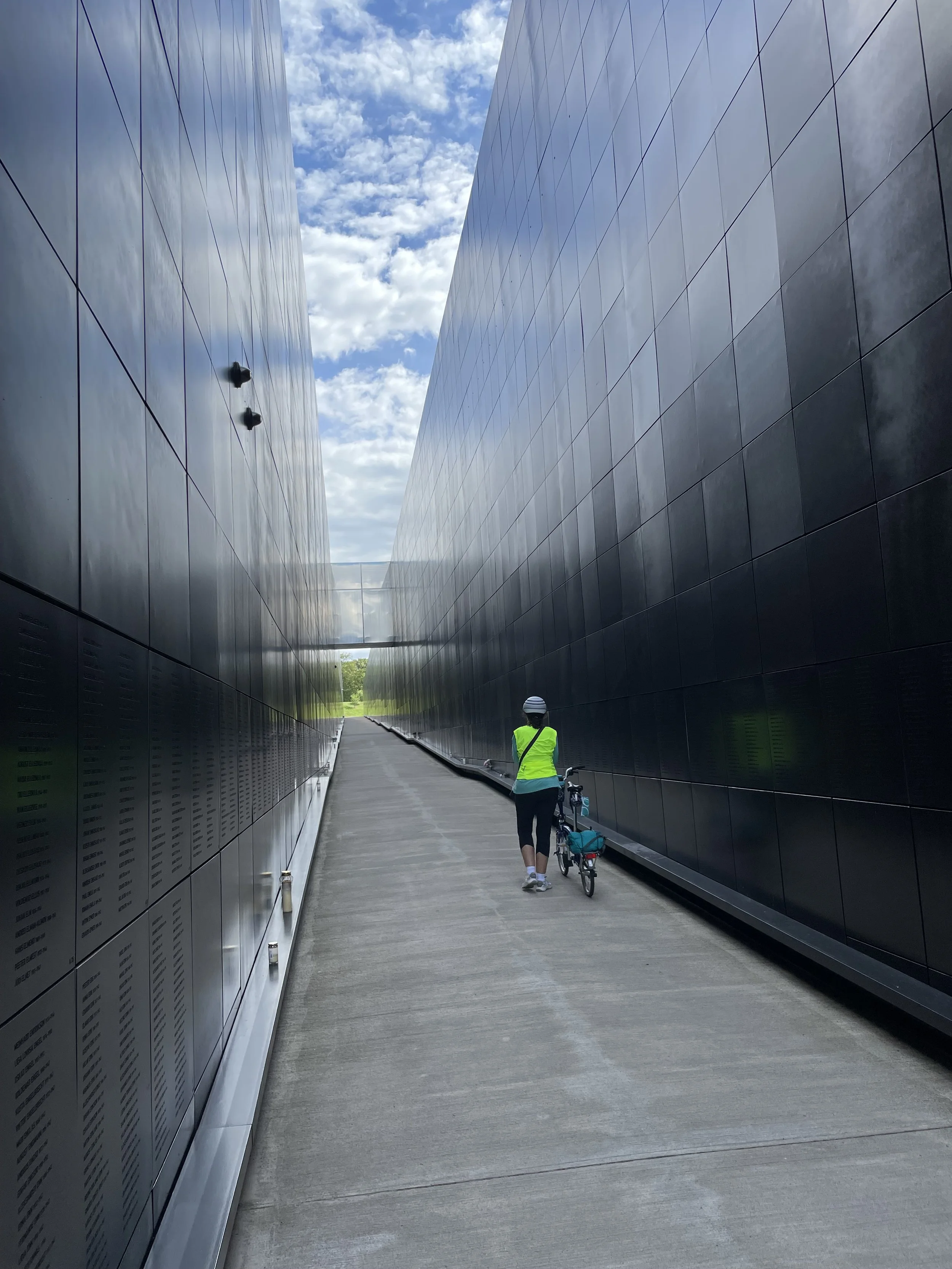
The names, the names, the names go on and on. More than 22,000 names are engraved on the memorial — people who never returned home, murdered or forced to leave. Many lie in unknown graves.
And even that list is incomplete.
An Unplanned Stop
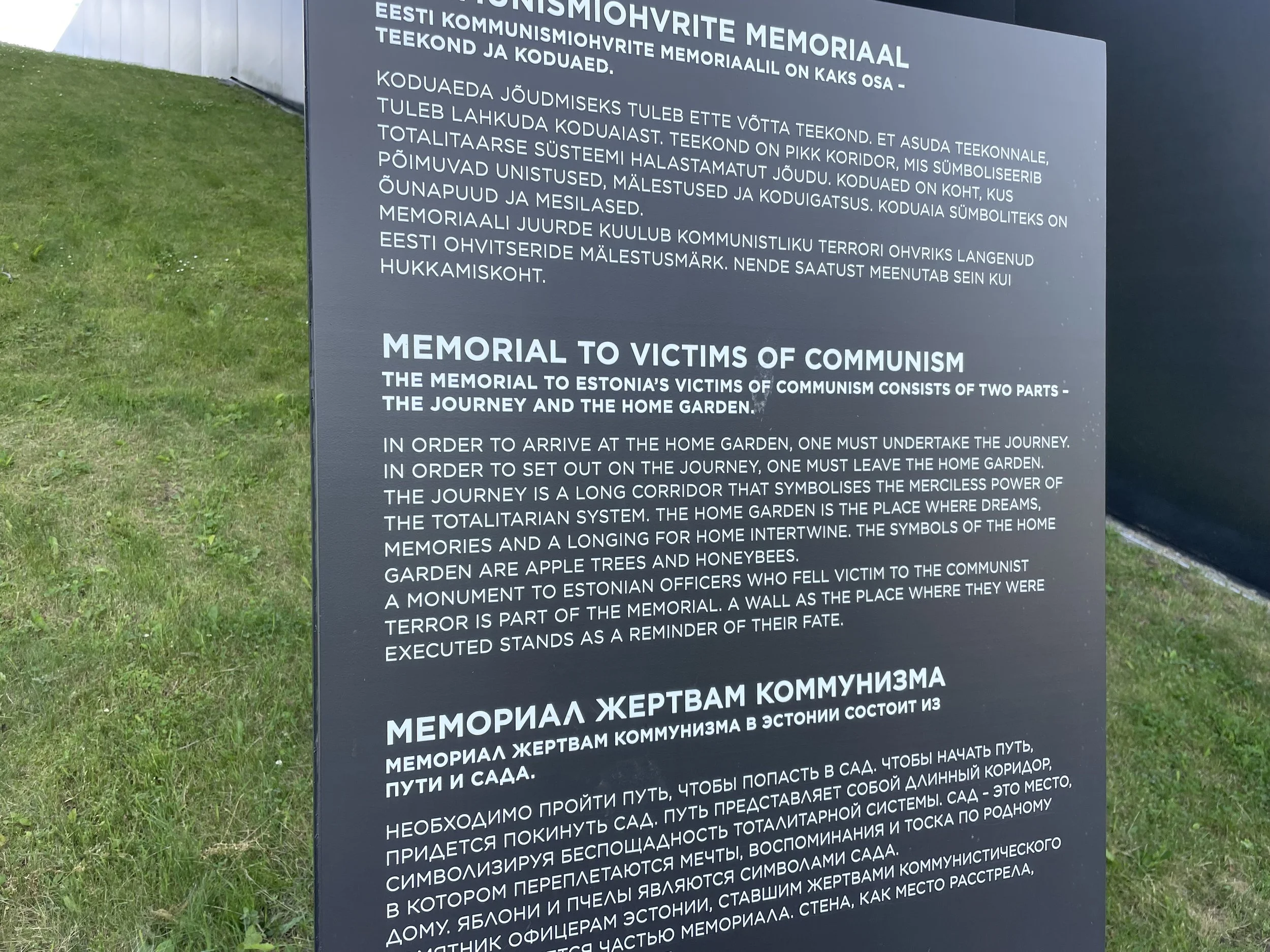
We happened upon a huge black structure beside our route.
We hadn't planned to visit it. We didn’t even know it was there.
It was the Memorial to the Victims of Communism at Maarjamäe.
The memorial is dedicated to Estonians who suffered under Soviet communist terror beginning with the occupation of Estonia in June 1940 and ending with restoration of independence in August 1991.
“The truth still rising, the lie sinking!”
The names, the names, the names go on and on.
Johannes. Hendrik. Leena. Aleksander. Ida. Martin. Peeter. Ludmilla. Amalia.
Birth year. Death year.
Birth year. Death year.
Birth year. Death year.
On and on.
“The truth still rising, the lie sinking!”
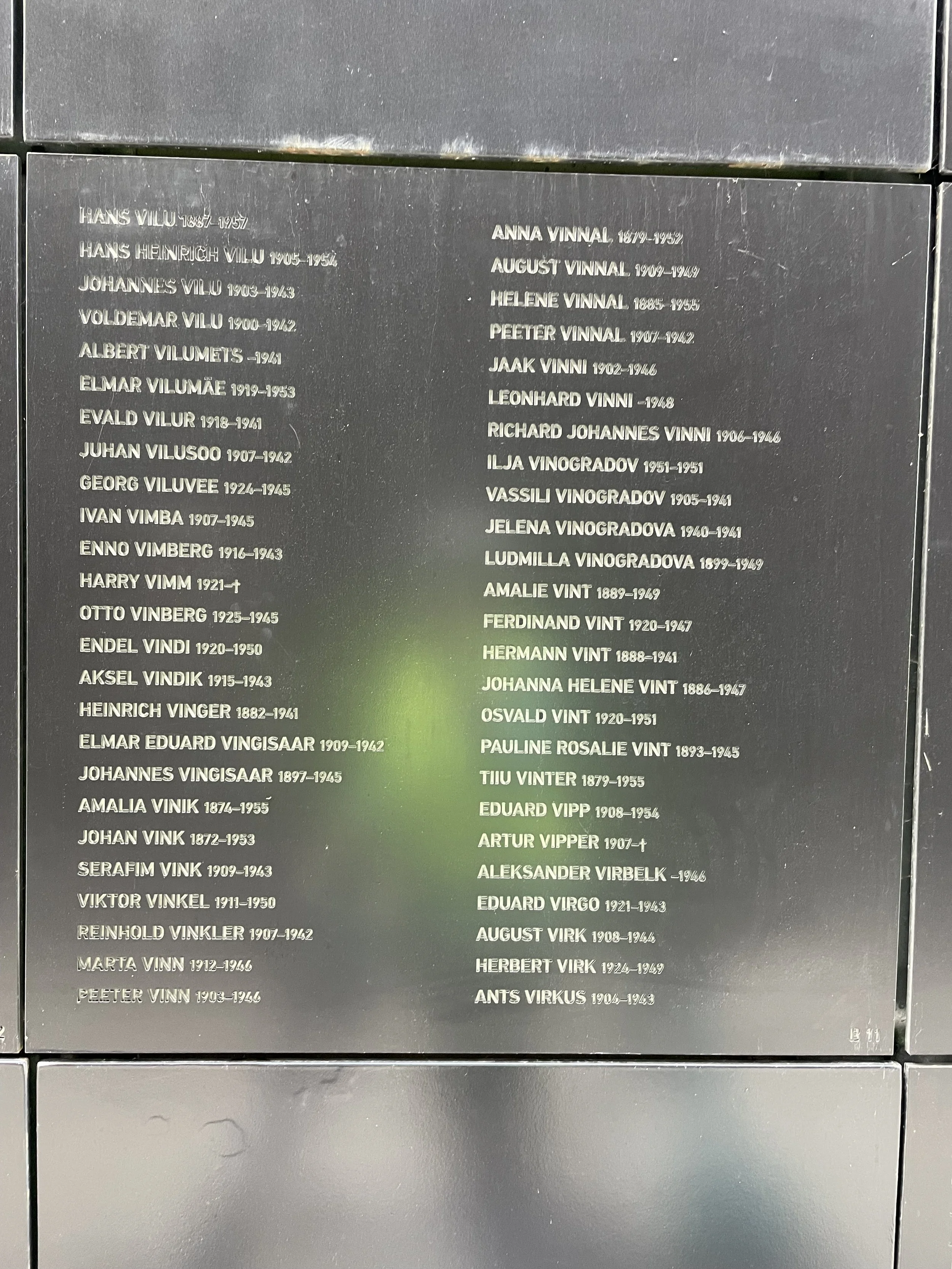
Other inscriptions acknowledge the people for whom even that much information doesn't exist: those whose last known fate was imprisonment or deportation, whose remains lie unnamed in forgotten cemeteries, prison camps and places of forced settlement.
And then there was this:
Children were born in forced exile.
“The truth still rising, the lie sinking!”
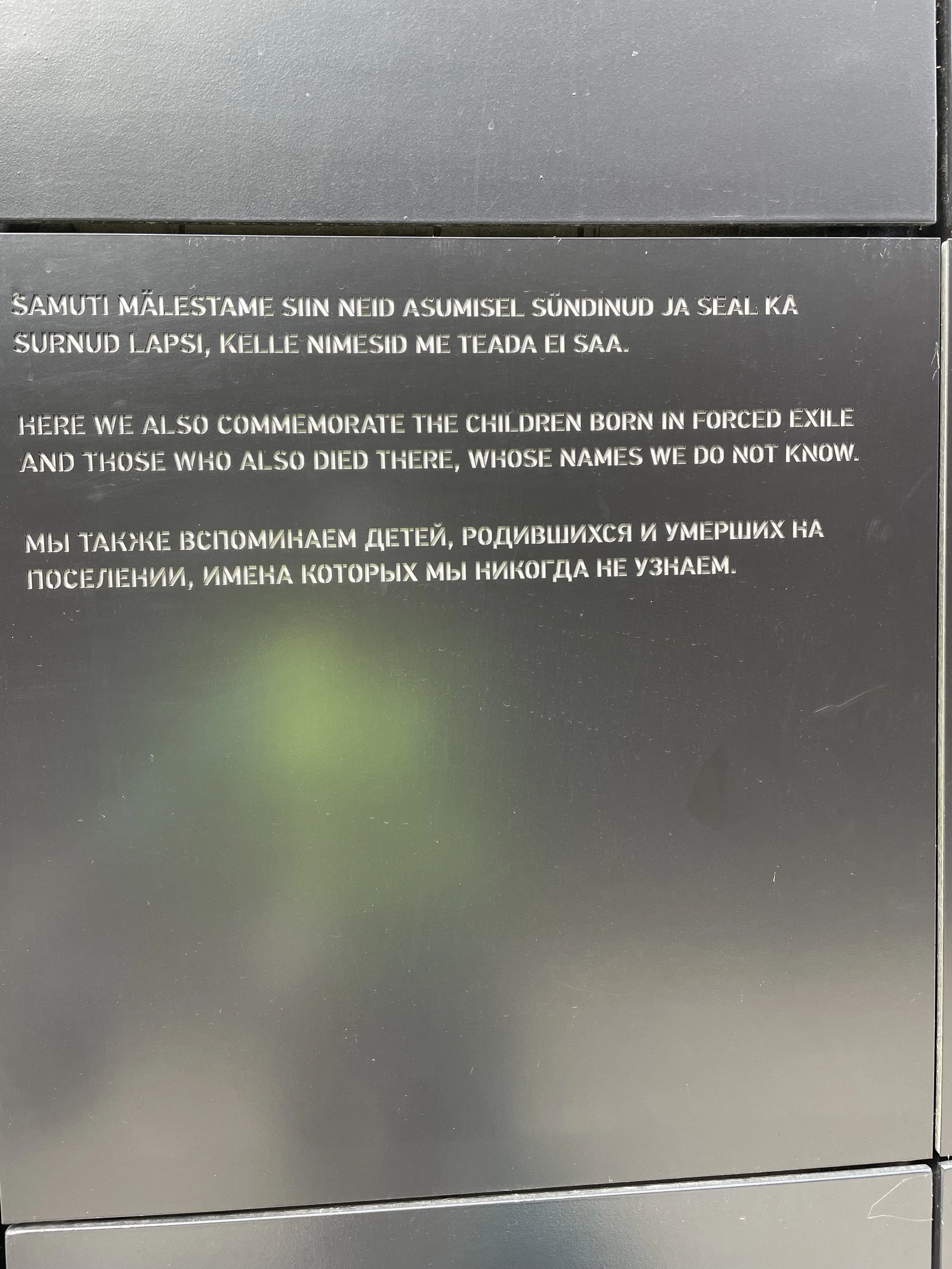
Some died there.
Their names aren't even known.
“The truth still rising, the lie sinking!”
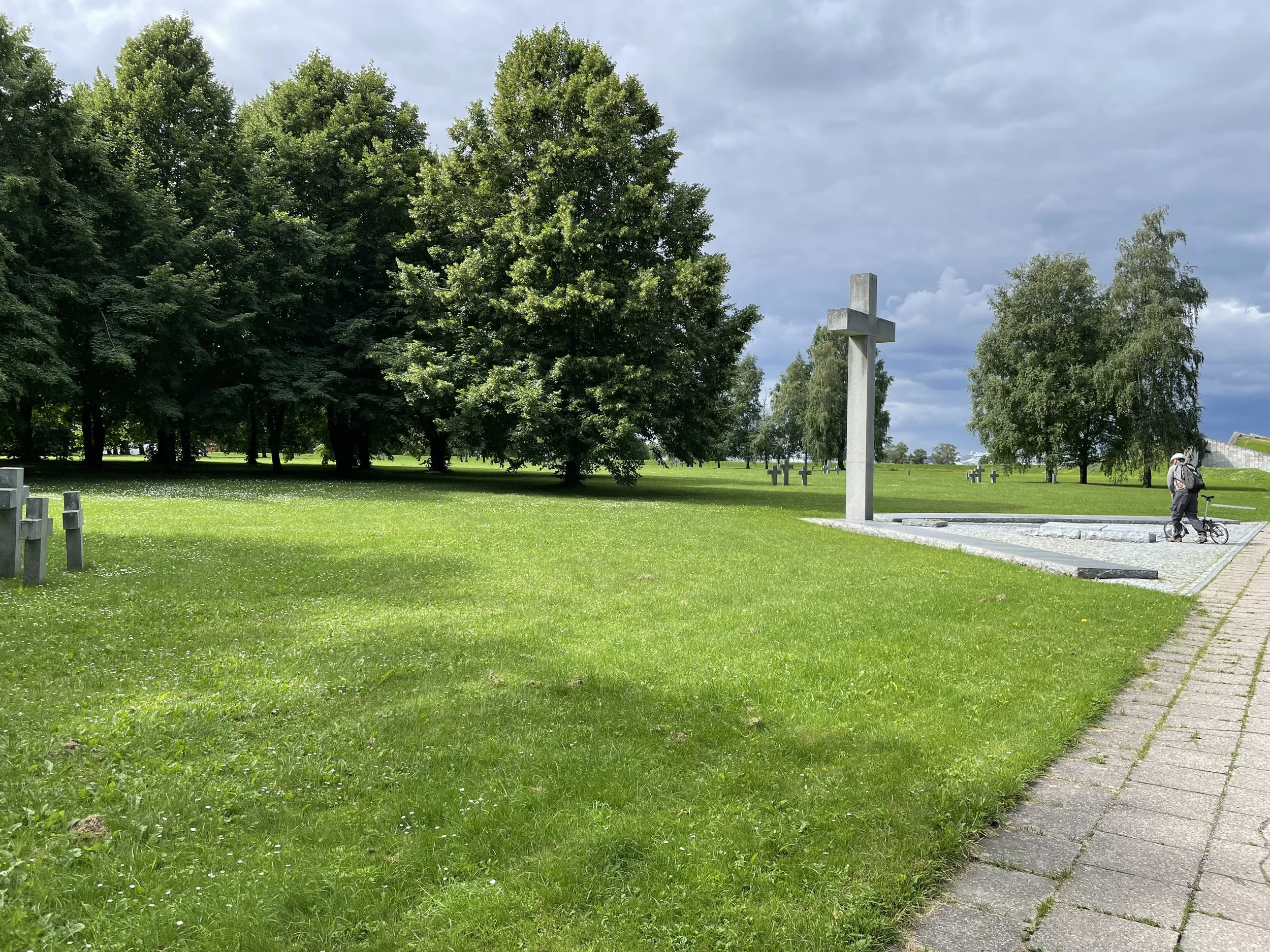
Nearby we found another layer of the country's complicated history: a German military cemetery from World War II, its stone crosses scattered across an extraordinarily peaceful green field.
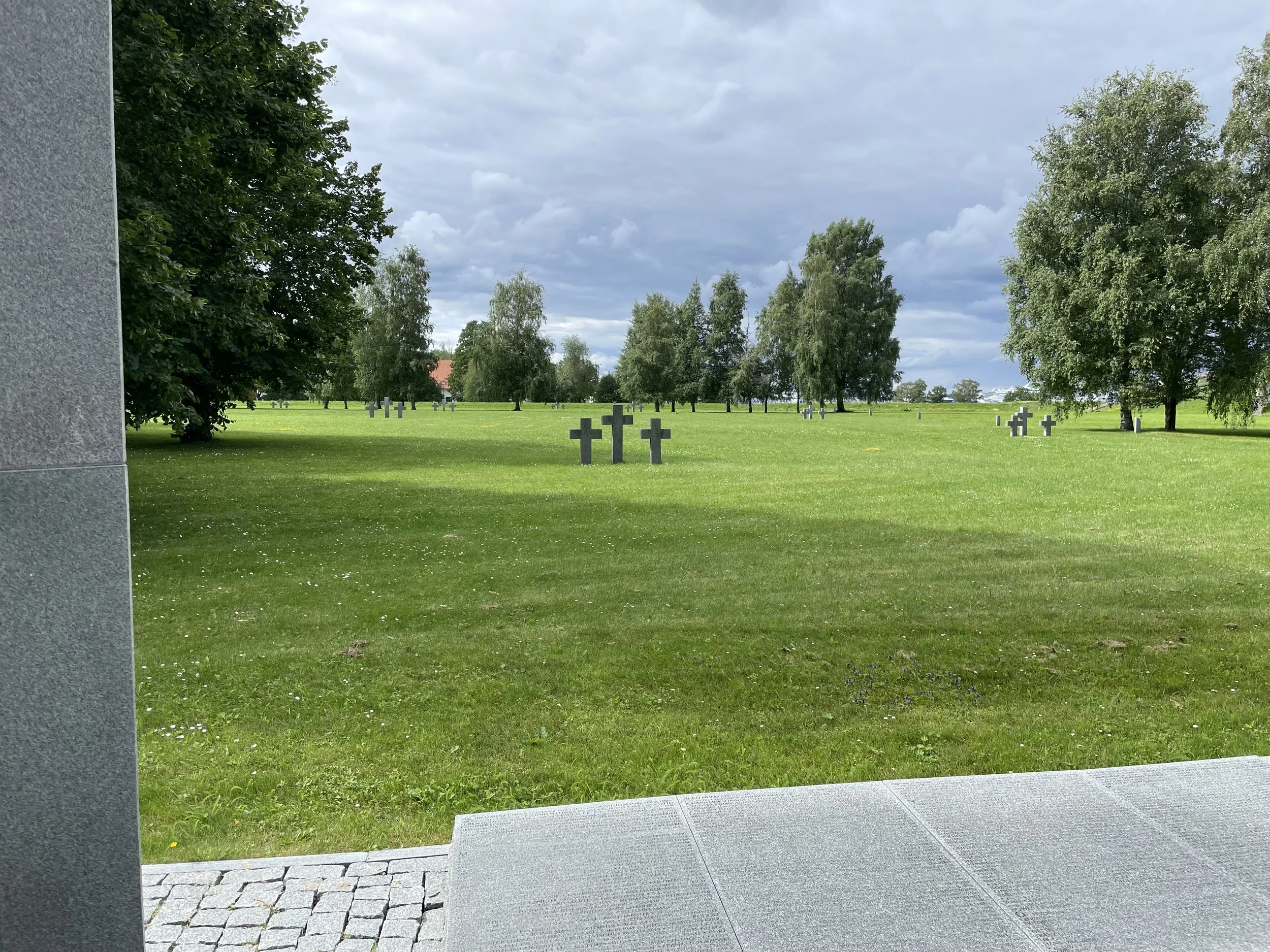
By then something about the entire day had changed.
We had started the morning looking for a bike ride.
Instead, history kept finding us.
From Darkness into a garden
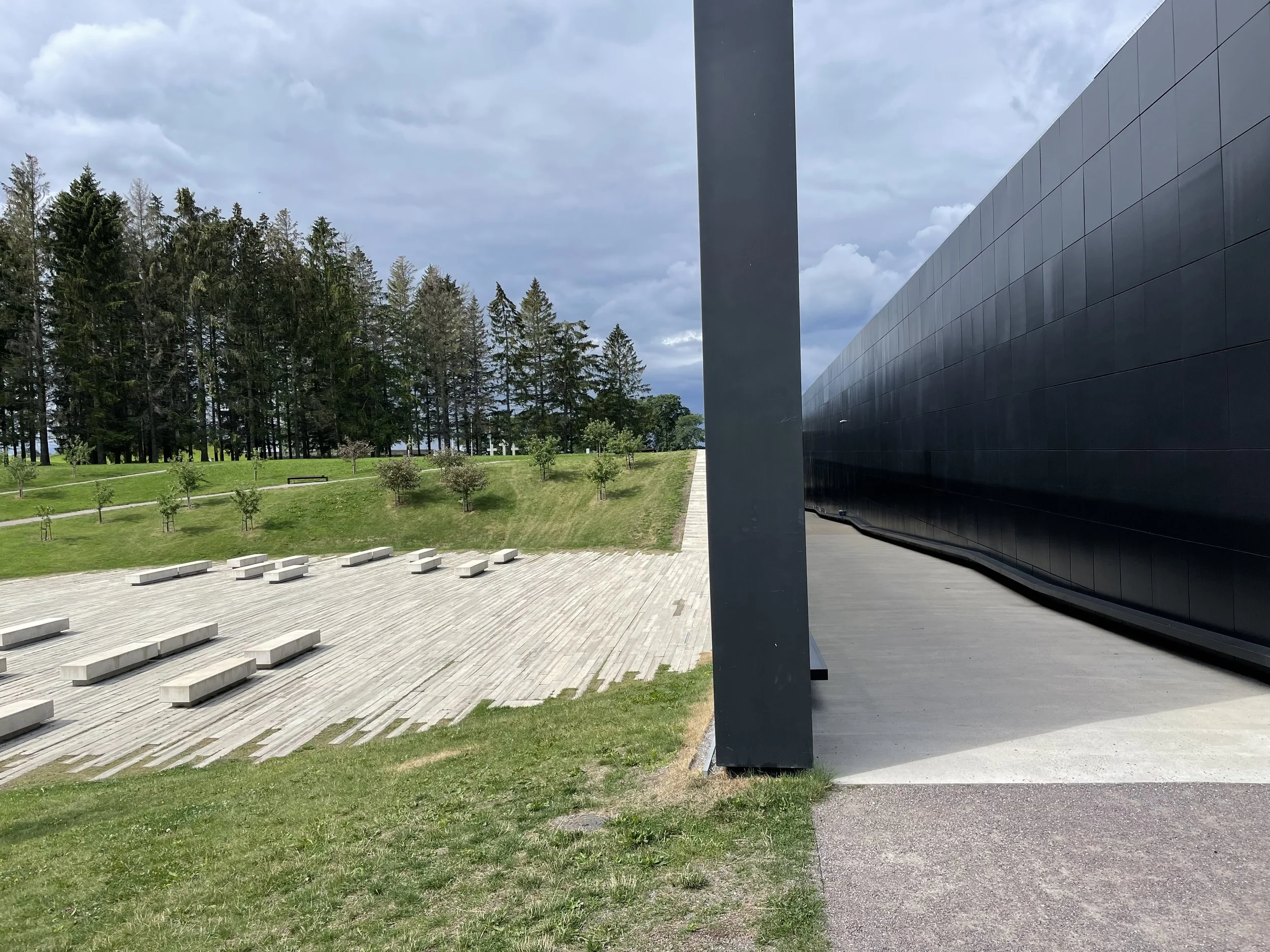
The architecture of the memorial is intentional.
The enormous dark corridor represents the crushing power of the totalitarian system. Beyond it is the Home Garden, representing the home from which people were torn — a place of memory, longing, apple trees and honeybees.
You move from darkness back into green space and sunlight.
Yet we don't want the final image from Tallinn to be the black stone wall.
And we don't want the final word to belong to Stalin, the KGB, the Soviet Union, Putin — or to any other human ruler who imagines that power is ultimately his.
The crosses in the green field reminded both of us of something infinitely larger.
Human beings can do terrible things to one another. Governments can become tyrannies. Innocent people can suffer terribly, and in this life some crimes remain unpunished and some wounds remain unhealed.
But evil does not get the last word.
God is still sovereign.
Jesus Christ has promised to return. He will judge rightly. He will wipe away every tear. And He has promised to make all things new.
So after a day spent riding through so many reminders of suffering and courage, perhaps the most fitting words are the simplest ones:
Come, Lord Jesus. Come.
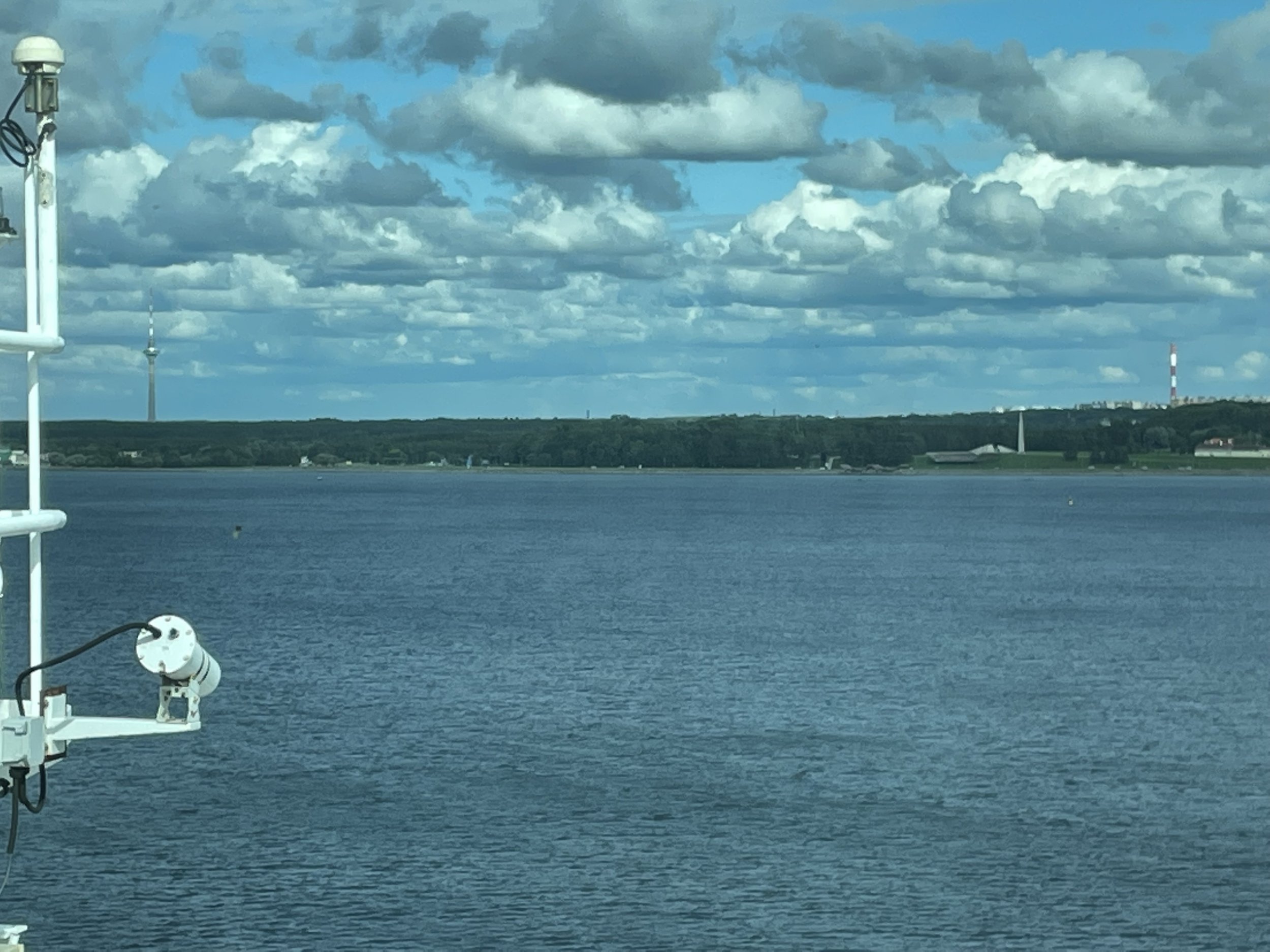
Tallinn in the late-afternoon light as we sailed away. The TV Tower is visible across the bay, to the left.
A ride through a country that remembers
Tallinn itself had been lovely.
We loved the empty morning streets of the Old Town. We loved the red bike lanes. We loved riding beside the Baltic and looking back at our ship. We loved the forest roads and the sheer freedom of having our Bromptons with us and being able to follow our curiosity for nearly twenty miles.
But that's not what we really remember about the ride.
We remember the door to the old KGB prison.
The protest signs outside the Russian Embassy.
The story of ordinary Estonians defending their television tower in August 1991.
The place in the forest where murdered people were found beneath the floorboards.
And finally those endless black stone walls filled with names.
Communism promises a society organized for equality and human flourishing. In reality, communist states have repeatedly concentrated extraordinary power in the hands of a few who used that power to stay in power, suppressing, imprisoning, torturing, and killing those who stood in their way.
Estonia knows what that looks like.
They lived it.
And in 2022, while Ukraine was again fighting for survival against its much larger Russian neighbor, it was impossible not to wonder how quickly the world forgets.
“The truth still rising, the lie sinking!”
The ride
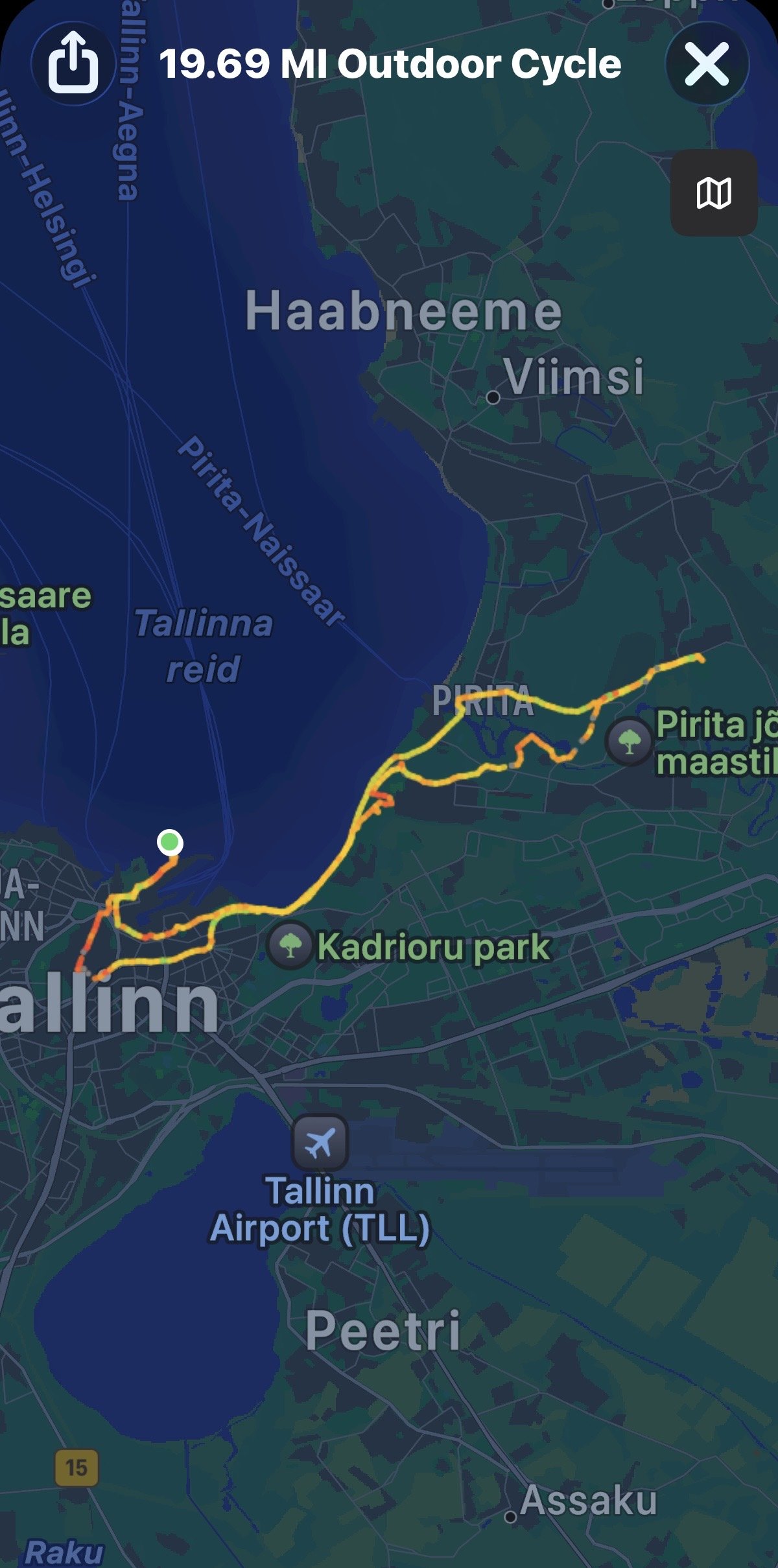
Ride: Tallinn cruise port -> Old Town -> Pirita waterfront -> Tallinn TV Tower -> Pirita River/forest trails -> Maarjamäe -> cruise port.
Distance: 19.69 miles.
Surface: City streets and cycleways, cobblestones, paved waterfront paths, forest paths and some unpaved trails.
Difficulty: Moderate, mostly because of distance; predominantly easy riding with a gradual inland climb toward the TV Tower.
Navigation: We improvised most of it. This worked surprisingly well, although today we might save offline maps before heading out.
What we liked: Extraordinary variety in one ride — medieval Tallinn, excellent urban cycling infrastructure, Baltic waterfront, forest riding and fascinating historic sites. Getting out early gave us an almost empty Old Town.
What we didn't like: Cobblestones aren't especially Brompton-friendly, and some of our improvised forest routing was uncertain. The heavier answer, though, is that some of what we encountered was difficult to see — which is precisely why we are glad we saw it.
Lesson learned: A bicycle lets you cover enough ground to connect places that would otherwise feel completely unrelated. It is worth leaving room in the day for what you don’t know you’ll find.
That’s the Fine Art of Knocking Around.